By Ochnology Solution Private Limited Team
Imagine two drums standing next to each other in a godown. In one of them is a brownish waxy material that needs to be heated before it can be poured out. In the other drum is an amber-colored liquid. These two items are both marketed as fatty acids, both receive inquiries from industrial customers in India, and are frequently confused far too often for comfort.
PFAD (palm fatty acid distillate) serves the soap line, feed mills and biodiesel manufacturers. TOFA (Tall Oil Fatty Acid) finds use in alkyd resins, dimer acids, lubricant esters and adhesives. Though these products are related, their origin, specifications and application areas are entirely different. Getting them confused may result in problems only later in the reactor.
The following guide provided by Ochnology, one of the industrial chemical suppliers for both materials, gives detailed information about the production process, properties of each product, its applications and specifications before ordering. For the current availability check our PFAD and TOFA supply range.
A fatty acid is an organic molecule composed of a chain of carbons along with an acid group
(-COOH) at the terminal position. The natural fatty acid molecules are contained within every fat and oil. Commercially, the fatty acids are obtained through either cleavage or distillation of the oil. The physical fatty acid chemical properties are dependent upon chain length as well as the number of double bonds in them.
There are very few applications in which the consumers seek them. Soap manufacturers require these fatty acids to produce soaps and soap bars. In the production of resins, the fatty acids are used in alkyl and polyamide systems of paints, coatings, and adhesives. For the preparation of lubricants, the fatty acids are converted into esters.
Fatty acid types are usually classified based on their saturation level. Palmitic and stearic acids are saturated, oleic acid is unsaturated with one double bond, while linoleic acid is unsaturated with two double bonds. The fatty acid composition of the product, or rather the content of individual acids, determines its classification. This is the reason why customers dealing with chemical raw material suppliers always request the composition first before asking for a price offer. Trade names cause confusion, since the liquid acid is often sold under the name of fatty acid oil.
Among industrial fatty acids, four names come up most often in Indian enquiries.
| Type | Where it comes from | Where it is used |
|---|---|---|
| PFAD | Distillate from palm oil refining | Soap, feed, oleochemicals, biodiesel |
| TOFA | Kraft pulping, through crude tall oil | Alkyd resins, dimer acids, lubricants, adhesives |
| Stearic acid | Vegetable oils, after hydrogenation and distillation | Rubber, candles, cosmetics, plastics |
| Oleic acid | Vegetable oils | Soaps, surfactants, textile chemicals, lubricants |
Our range also covers stearic acid. This guide stays with the pair buyers swap most.
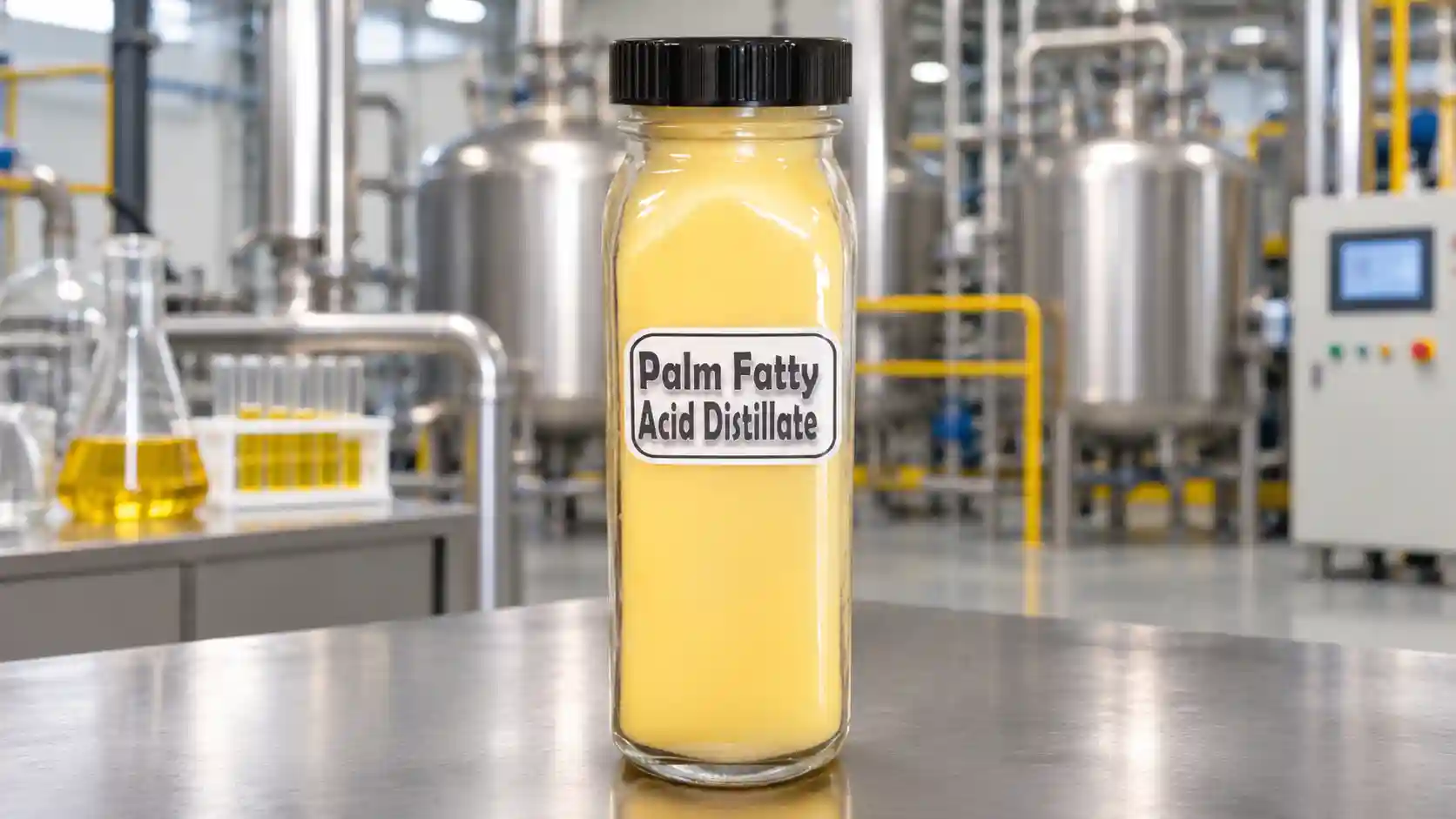
PFAD is one of the principal palm oil byproducts. Physical refining involves heating of the crude palm oil in vacuo using steam. It leads to removal of the free fatty acids and all volatile matters. The vapors are condensed into a brown distillate. Refiners have no plans to produce it; that is why its price is that of an unprocessed product.
Its quotations are made using different designations like palm fatty acid distillate, palm fatty acid, palm oil fatty acid or plain fatty acid distillate. Its chemical composition includes mainly the free fatty acids like palmitic and oleic acids, as well as glycerides and small amounts of sterols, tocopherols, and squalene. At room temperature it is a semi-solid brown product.
The origin of TOFA is in a pulp mill. During kraft cooking of pine wood, a layer of soap floats on the spent liquor and can be recovered by adding acid to it to obtain crude tall oil. The crude is then separated into fractions by vacuum distillation. The fatty acid fraction is called TOFA, and rosin acids, which are larger molecules, are removed in rosin and pitch streams, which are also from the same wood.
The double bonds in TOFA make it reactive to the resin manufacturers desire, and are dominated by oleic and linoleic acids. It is yellow to brown in color at room temperature. A special naming error to note is that distilled tall oil (DTO) retains significantly more rosin than TOFA and thus has different applications. The supply of crude tall oil from kraft pulp mills is also used by Tall oil fatty acid manufacturers, and supply is tied to kraft pulp production.
| Feature | PFAD | TOFA |
|---|---|---|
| Source | Palm oil refining by-product | Kraft pulping (pine) by-product |
| Main acids | Palmitic and oleic | Oleic and linoleic |
| Key spec | Free fatty acid; commonly offered at 70% minimum (confirm on COA) | Acid value and rosin acid content |
| Form at room temperature | Semi-solid, brown | Liquid, yellow to brown |
| Main uses | Soap, feed, oleochemicals, biodiesel | Alkyd resins, dimer acids, lubricants, adhesives |
| Typical buyers | Soap and oleochemical makers | Coating, resin, lubricant and adhesive makers |
Start with end uses first. An inexpensive drum of the incorrect acid is more expensive after it gets to the reactor.
PFAD uses, or palm fatty acid distillate uses in plant terms, cluster around four areas.
Decide by end use first. A cheaper drum of the wrong acid costs more once it reaches the reactor.
The list of tall oil fatty acid uses is longer, and most of it is chemistry-led. Coating makers cook it into alkyd resins for paints, where the unsaturation drives drying behaviour. Polymer producers join its oleic and linoleic acids into dimer acids, the base for polyamide resins and hot-melt adhesives.
Beyond those two, TOFA turns up in:
The table gives typical ranges for guidance. Actual values differ by grade and batch, so confirm every figure against the supplier's current TDS and COA.
|
Parameter |
Typical value or note (confirm against COA) |
|
Free fatty acid (as palmitic) |
Commonly offered at 70% minimum. Higher-FFA grades exist, so confirm. |
|
Moisture and impurities |
Commonly offered at 1% maximum. Some grades list lower. |
|
Saponifiable matter |
Commonly offered at 95% minimum. |
|
Saponification value |
About 195 to 210 mg KOH/g. |
|
Iodine value |
About 45 to 55 g I2/100 g. |
|
Palmitic acid (C16:0) |
About 40 to 48%. |
|
Oleic acid (C18:1) |
About 30 to 38%. |
|
Colour and appearance |
Brown, semi-solid at room temperature. State the colour value from the COA. |
|
Packing |
Bulk, ISO tank, flexitank or drum (confirm what the supplier offers). |
Read FFA first. More free fatty acid means more usable acid per tonne, and if the COA reports acid value instead, multiplying it by roughly 0.457 gives FFA as palmitic. Next comes moisture and impurities, because you pay freight on water and dirt and both cause trouble in processing. Saponifiable matter shows how much will actually turn into soap.
|
Parameter |
Typical value or note (confirm against COA) |
|
Fatty acid content |
About 95% minimum in the top grade. |
|
Acid value |
About 190 to 200 mg KOH/g. Primary spec for alkyd reactivity. |
|
Saponification value |
About 192 to 202 mg KOH/g. |
|
Iodine value |
About 130 to 145 g I2/100 g. Measures unsaturation and drying behaviour. |
|
Rosin acid content |
Roughly 1 to 5% depending on grade. Lower is better. |
|
Unsaponifiables |
State the maximum from the COA. Lower suits alkyd and dimer acid use. |
|
Colour (e.g. Gardner) |
State the value. A lighter colour usually points to a cleaner grade. |
|
Moisture |
State the maximum from the COA. |
|
Packing |
Bulk, ISO tank, flexitank or drum (confirm what the supplier offers). |
While rosin acids originate from the same sources as TOFA, their large ring structure does not react well during alkyd and dimer acid synthesis. They thus tend to dilute the beneficial fatty acid, resulting in a darkened and slowly drying/duller resin. This is why resin and coating clients prefer low levels of rosin and require this information to be stated on the COA.
The PFAD will be semi-solid at cold temperatures; hence, unloading should be done by heating evenly without any local heat spots because heating it too much causes darkening. Hot fatty acids can corrode mild steel; thus, using stainless steel tanks or properly lined ones would be more preferable. The TOFA is unsaturated and tends to oxidize. Make sure both materials are sealed from moisture and air.
Shipping is done in bulk tankers, ISO tanks, flexitanks, or drums. Let us know in advance if you want drums or bulk.
Standard documentation consists of an invoice, packing list, certificate of analysis (COA) and safety data sheet (SDS). In case the certificate of origin is needed in the destination country, this document will be provided together with the shipment. There are some PFAD buyers, mostly biodiesel, who also ask for sustainability documentation such as RSPO and/or ISCC. Ask the supplier about documentation that he/she can provide for your grade.
The COA comes, and there are four things to check before accepting the batch:
Before placing the order for imported goods, make sure you know about the current import policy, duties, and classification. Normally, these materials are classified under heading 3823, but check the classification with your customs agent since the rules and duties change from time to time.
The price of PFAD is influenced by crude palm oil prices, FFA grade, transportation cost and import duty. The price of TOFA is influenced by pine pulp production, crude tall oil availability, rosin value, and color grade. Both products do not have a fixed price; so get the price based on your requirement.
When selecting a fatty acid suppliers or even a tall oil fatty acid suppliers for your new product grade, ask the same set of questions to all of them. Can they provide the TDS as well as a batch certificate of analysis? What packing and shipping alternatives do they have? Do they have any documentation on sustainability or origin? And what is their consistency from batch to batch?
When you are ready for a quote, send the product, grade, quantity, packing and delivery port. Buyers in South India can start with our fatty acid supply in Coimbatore, Western India; inquiries are handled through our industrial chemical supply in Mumbai, and Gujarat buyers can reach us through chemical sourcing in Ahmedabad.
Ochnology works with B2B buyers on specification, documentation and shipment planning.
These figures describe Ochnology's business in general and do not guarantee that every grade is available. Confirm the grade and supply terms for each requirement.
PFAD and TOFA are both fatty acids, but none can substitute for the other. PFAD is derived from the palm oil refining process and is used in soap, feed, oleochemicals, and biofuels. TOFA is produced from the pine pulping process and finds application in resins, coatings, lubricants, and adhesives. Decide on the intended purpose first before comparing their respective figures which include FFA and moisture for PFAD and acid value and rosin content for TOFA.
|
Read the COA before you accept any batch. To get a quote, send your requirement to Ochnology with the product, grade, quantity, packing and port. |
PFAD is an acronym for Palm Fatty Acid Distillate. This is an industrial byproduct of palm oil refinement containing large amounts of free fatty acids, usually 70% or above. It is sold as an inexpensive raw material for soap, feed, oleochemicals, and biodiesel.
TOFA is an acronym for Tall Oil Fatty Acid. It is extracted by distillation of crude tall oil which is obtained as a byproduct of pine wood pulping process separating fatty acids (oleic and linoleic) from rosin acids.
The source is given first. PFAD is derived from palm oil, which is high in palmitic and oleic acid, whereas TOFA is derived from pine pulp, which is high in oleic and linoleic acid. PFAD has its main uses as soap, feed, and biodiesel. TOFA is used for resins, coatings, lubricants, and adhesives.
Soaps dominate the application. PFAD produces laundry soaps and soap noodles, and it acts as an energy source in animal feed, oleochemistry raw materials and biodiesel raw material.
PFAD is usually available with 70% minimum free fatty acid, expressed in palmitic acid basis, with moisture and impurities not more than 1%. Always check the exact percentage in each batch through the COA.
Paint and coating alkyds are the major applications. TOFA also finds application in dimer acids, lubricant esters, adhesives tackifiers, soaps and surfactants, oil field chemicals, ore flotation and construction chemicals.
Rosin acids degrade the quality for the resin industry. The less rosin there is, the purer the fatty acid is, and that is what they want.
Generally, an invoice, packing list, certificate of analysis and safety data sheet. In addition, a certificate of origin if the destination country needs it. The sustainability certificates will be provided only if the supplier has them.
Connect with Ochnology for dependable industrial sourcing and supply.