We describe in detail how our quality system functions, the significance of each test method we employ, and our protocol if anything goes wrong, as well as our numbering of COAs. No jargon, just our system.
We leave our facility with a Certificate of Analysis for every batch we make, NOT catalogue minimums! This page is for you if you're looking for a trusted and approachable supplier. You'll discover our precise testing methods, applicable requirements, batch traceability system, and paperwork structure – the exact information our buyers rely on before each shipment departs our facility.
Request Quality Documents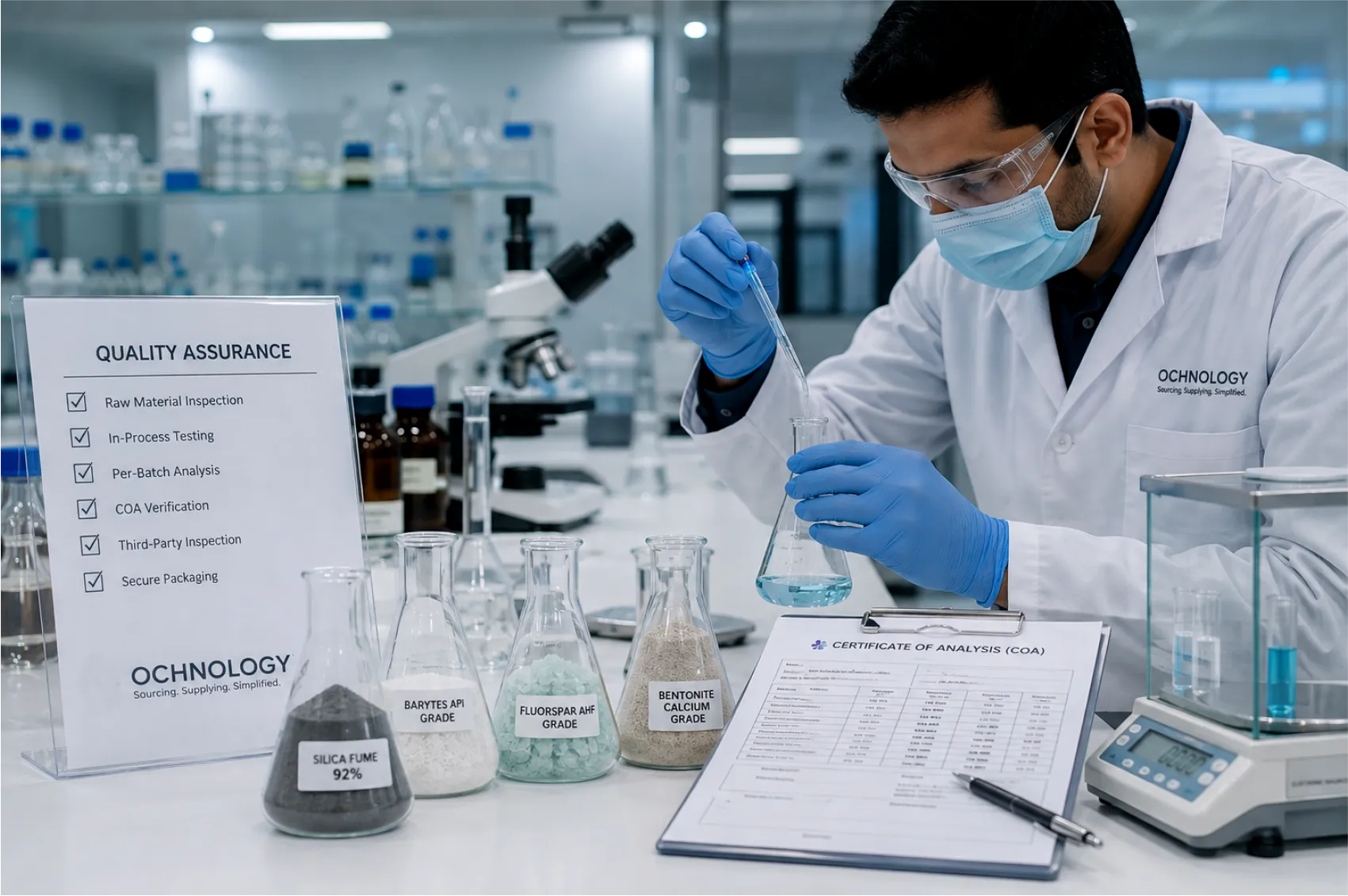
At Ochnology, quality is not a characteristic we attribute to our products. It is a scientifically measurable, documented, batch-specific final product — it doesn't say minimum, it says actual numbers.
Our COA values are actual test results from the respective batch, not minimum specifications or rounded figures. Our buyers have shared these COAs with engineers and clients without retesting, because the numbers speak for themselves.
Our sourcing and processing of raw materials ensure chemical composition is held to a close variance for each production run. The same specification is provided to QC managers, shipment by shipment, with no surprises forcing a re-qualifying of your incoming inspection process.
Each batch COA can be cross referenced with our internal test register or verified through our NABL accredited testing lab partnership with a request. We also arrange SGS/ Bureau Veritas / Intertek / Cotecna pre-shipment inspections for customers who need a third party certificate of sign-off.
Each clause in ISO 9001:2015 is both understood and acted upon with measurable steps towards improvement.

Understand internal & external factors that impact our objectives and performance.

Establish clear roles and responsibilities and commitment from top management.

Risk based thinking, Quality Objectives & Planned Actions for consistent outcomes

Resources, competence, awareness & communication that make for quality.

Sourcing to delivery with documented standards.
Monitor, measure & analyse for effectiveness.

Corrective actions, continual improvement & innovation.

These are the same analytical techniques used throughout our product range and are selected for each product to comply with the purchase specification standard appropriate to the product.

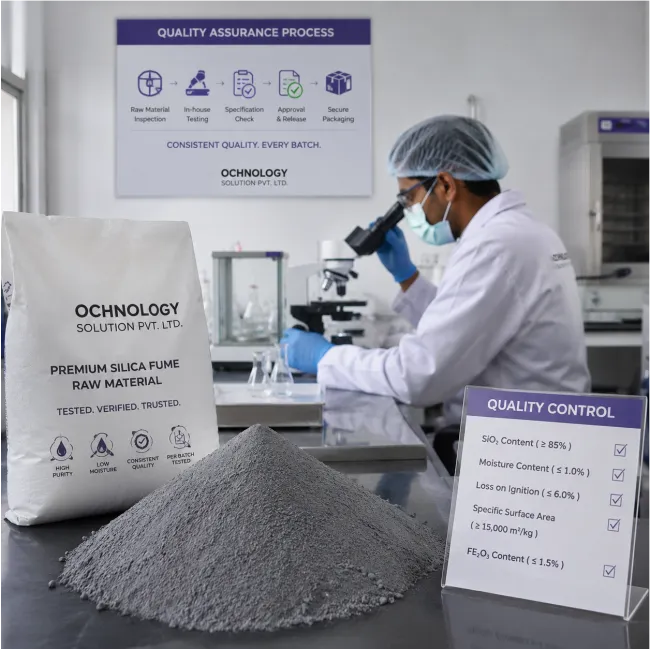
The major chemical component test method. Non-destructive. Furnishes multi-element analysis in minutes and with a precision of ±0.01% for major oxides. Used for each batch of each product type.

Wet laser diffraction using Mie scattering theory (ISO 13320). Measures full PSD from 0.1 to 3000 µm. Reports D10, D50, D90, D97 — critical for paper coating, paint, ceramics, and refractory castable applications.

Specific surface area is important in the determination of Silica Fume (pozzolanic reactivity), Calcined Bauxite, and fine mineral powders. Blaine air permeability of cement-related products; BET nitrogen adsorption of ultra-fine material.

Gravimetric moisture analysis (105°C oven drying to constant weight) and Loss on Ignition (LOI) at 950°C. Critical for hygroscopic products, chemical reactivity calculations, and ensuring safe storage and handling.

Using a calibrated photoelectric reflectance meter (UV filter) – ISO 2470 brightness and CIE Lab colorimetry. Critical for Kaolin (paper coating), Calcium Carbonate (paint/paper), and Talc (cosmetic/plastic).

Strength Activity Index test for Silica Fume – (ASTM C1240). Mortar cubes cured at 28 days and compared with control. Essential to concrete and refractory castable applications for which guaranteed pozzolanic reactivity is required.
Standards We Test To:ASTM-C1240 ASTM-C114 IS-15388 IS-505 EN-13263 ISO-13320 ISO-2470 BS-EN-196-2 API13A ISO-9277
CERTIFICATE OF ANALYSIS-SILICA FUME
COA-SF2505-2025-3197
COA-SF2505-2025-3197
COA-SF2505-2025-3197
| Parameter | Specification | Result | Status |
|---|---|---|---|
| SiO2 Content | ≥ 85.0% | 92.4% | ✓ PASS |
| Moisture Content | ≤ 2.0% | 0.4% | ✓ PASS |
| Specific Surface | ≥ 15,000 m2/kg | 18,600 m2/kg | ✓ PASS |
| LOI (at 1000°C) | ≤ 6.0% | 2.1% | ✓ PASS |
| Chloride (as Cl-) | ≤ 0.05% | 0.02% | ✓ PASS |
Know what every field means on our Certificate of Analysis.
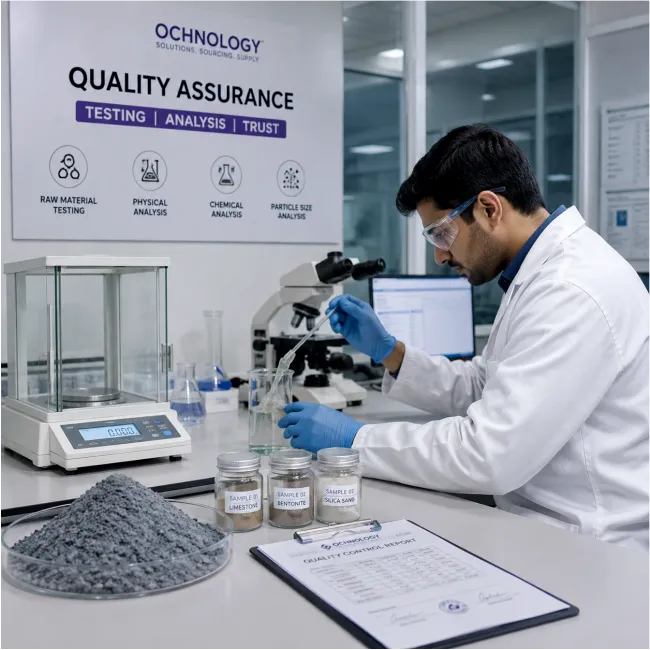
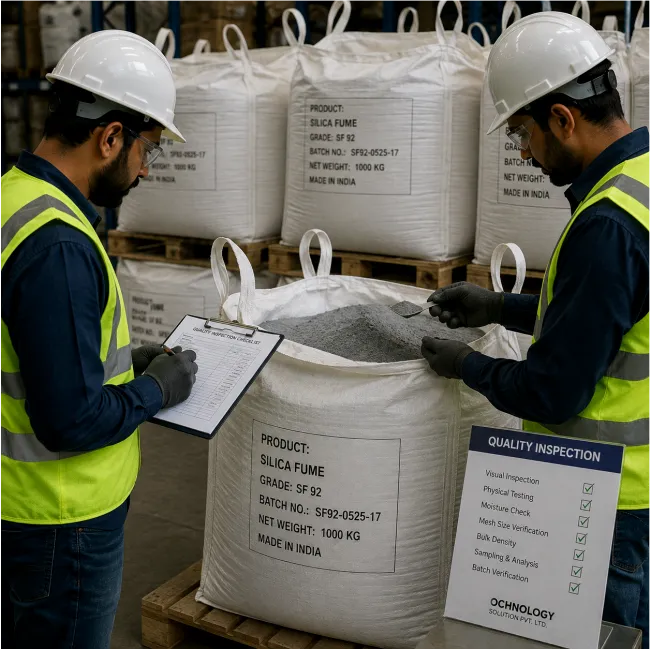
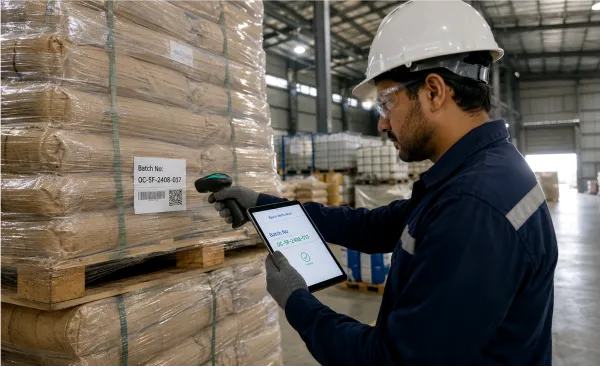
Format: OCH- [Product Code]- [Year] -[Lot Number]. Each batch number is unique and will be found on the COA, packing label, and in the production record. Traceable, both ways — source to delivery and delivery to source.
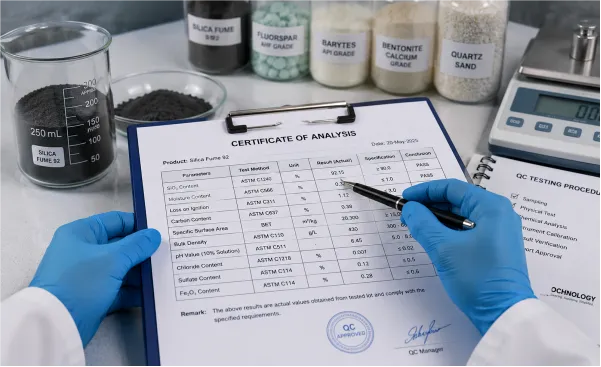
The “Actual Result” column indicates the lab results for that batch. If SiO₂ came out 93.4%, the COA says 93.4% — not “+92%”. Your engineers and QC team have a clear idea of what they have received.
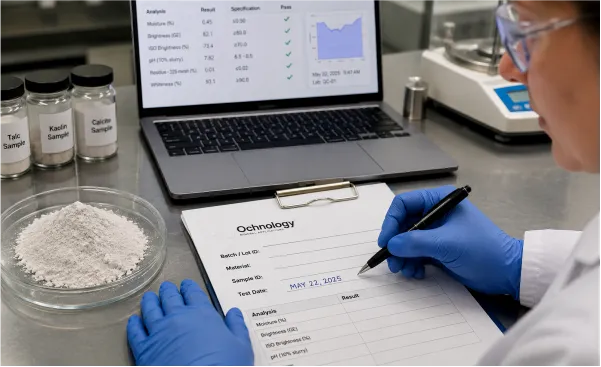
The test date reflects when that specific batch was analysed and not when the product specification was last reviewed. Different production runs have different test dates and different COAs.

The QA lab reference number can be checked against our lab test log. The external lab reference can be independently verified with the testing laboratory for NABL-verified batches.
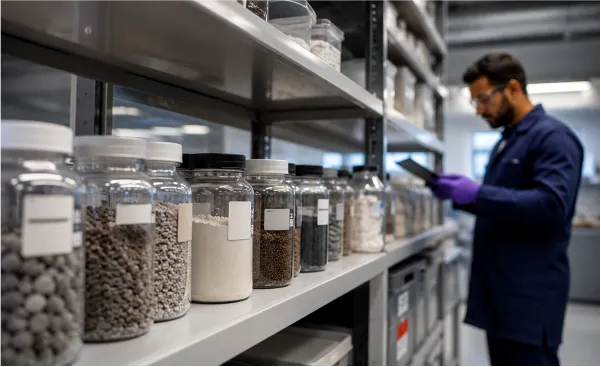
A sample of each batch is kept as a reference sample in a sealed container for 6 months after shipment. In the event of a quality disagreement, we can draw the sample from the same batch and re-test the sample to compare the results.
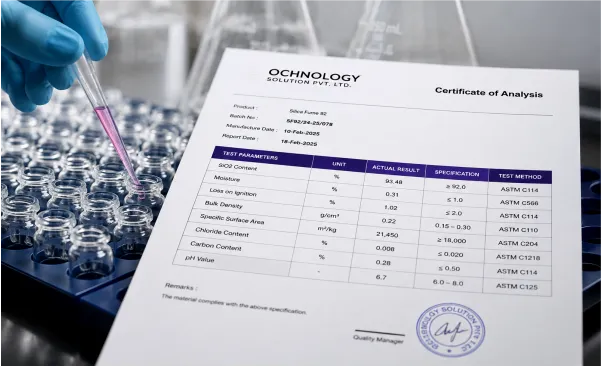
The “Actual Result” column lists the actual result obtained for that batch in the lab. If SiO₂ came out 93.4%, the COA says 93.4% — not “+92%”. Your engineers and QC team are aware of precisely what they received.
A quick reference for QC managers specifying which test standard to request on each Ochnology product COA.
| Product | ASTM | IS / BIS | EN / BS | API | ISO | GHS SDS |
|---|---|---|---|---|---|---|
| Silica Fume (Microsilica) | C1240 | IS 15388 | EN 13263 | Not Applicable | ISO 9277 | Available |
| Limestone / Calcium Carbonate | C114 | IS 1514 | EN 196-2 | Not Applicable | ISO 13320 | Available |
| Kaolin / China Clay | C837 | IS 505 | EN 12670 | Not Applicable | ISO 2470 | Available |
| Calcined Bauxite | C71 | IS 1528 | EN 1402 | Not Applicable | Available on Request | Available |
| Barytes (Barite) | Available on Request | IS 12388 | Available on Request | API 13A | Available on Request | Available |
| Bentonite | Available on Request | IS 6186 | Available on Request | API 13A | Available on Request | Available |
| Soda Ash (Dense / Light) | E113 | IS 251 | EN 497 | Not Applicable | ISO 919 | Available |
| Xanthan Gum | Available on Request | Available on Request | E415 / FCC | API Grade | ISO 11213 | Available |
Complete supply chain traceability works in two directions while providing total transparency. From your delivery note, you can seamlessly trace materials all the way back to their original quarry. At the same time, we can identify any customer complaint and trace it back to find all the specific shipments associated with the same production batch. This provides unparalleled quality control, accountability, and safety throughout all operations. This traceability structure is built into every batch record from day one, not reconstructed after a dispute. Any batch can be selected by auditors and QC staff to provide the full production, testing, and dispatch trail.
Each batch number includes a product code, year code, and sequential lot, meaning that any member of our team can instantly read it.
COA-SF2505-2025-3197
COA-SF2505-2025-3197
COA-SF2505-2025-3197
Sequential lot number within the year (001 → incrementing)
Retained sample policy: A sample that has been sealed and labeled from each batch is kept for 6 months from the shipment date. Batches that are involved in a quality dispute are kept in the queue and cannot be moved back into the main queue until the dispute is settled. Independent re-testing of reference samples on written request.
Criteria used to qualify and re-qualify raw material suppliers annually
Chemical Specification Accuracy
Critical
Batch-to-Batch Consistency (CV%)
Critical
On-Time Delivery Rate
Major
COA Accuracy vs Our Test
Critical
Environmental Compliance Cert.
Major
Response to Quality Issues
Minor
Packaging & Labelling Quality
Minor
AVL gate: Suppliers assessed based on quality, compliance, documentation, capacity and delivery. The vendor who received a score below the minimum required is placed under corrective action or the vendor is suspended until the minimum score is obtained.
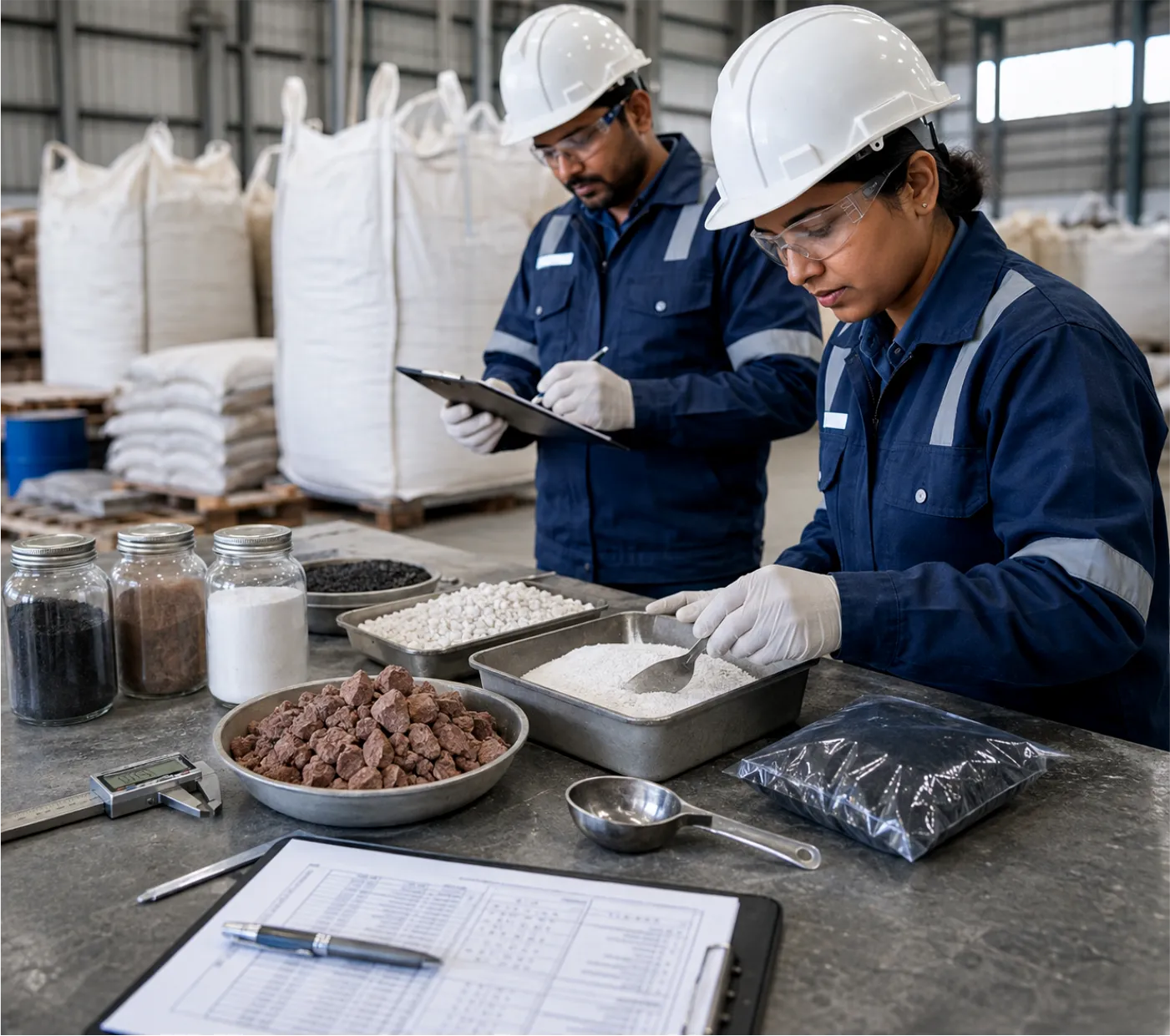
We don't start our QC process at the last test point. It starts from sourcing the raw materials. A supplier who delivers substandard raw material is never in the race. Producing quality products should always be the aim.
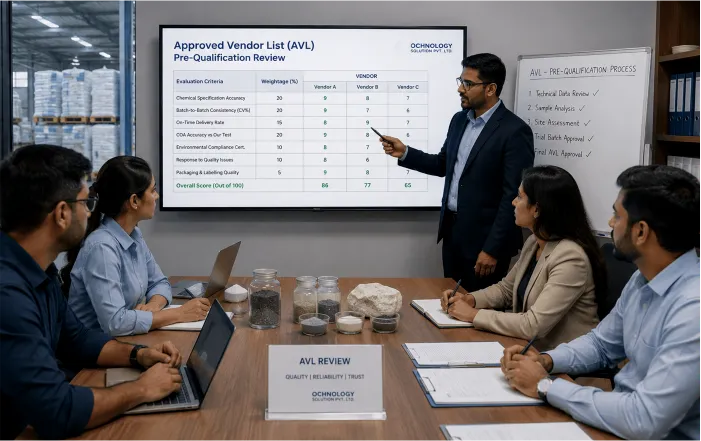
New raw material suppliers undergo a qualification process: technical data review, sample analysis, site assessment or audit questionnaire, and minimum three consecutive trial batch approvals before being added to the AVL.
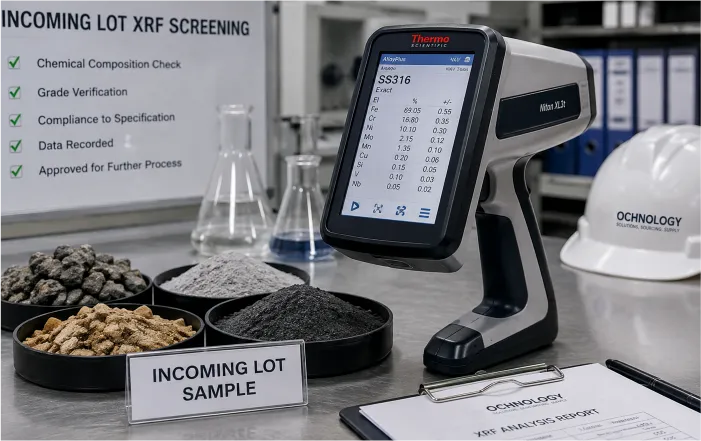
Every delivery of raw material is XRF-screened on arrival. Material whose chemistry falls outside the acceptable incoming range is quarantined and returned, regardless of the supplier's own COA claims.
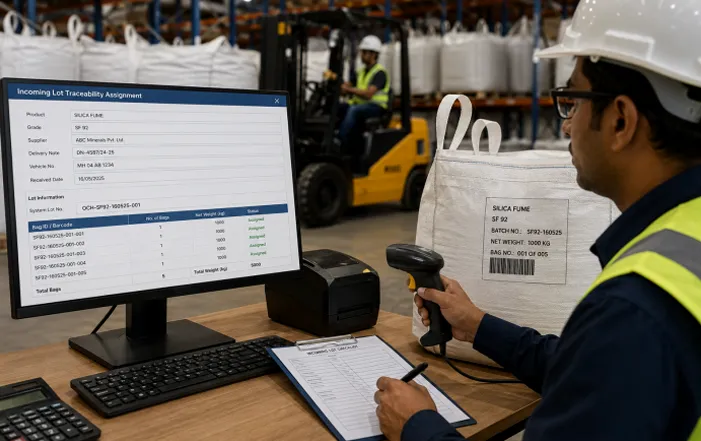
Accepted material is assigned an incoming lot number, stored in a designated area, and tagged. The incoming lot number becomes part of the batch genealogy for every production batch that uses it.
Our packaging specifications are not chosen for cost — they are chosen to ensure the product that passes our QC test is the same product that arrives at your facility, regardless of transit conditions.

All hygroscopic products packed with heat-sealed HDPE inner liner inside the outer bag. Prevents moisture ingress during sea transit — critical for Silica Fume, Soda Ash, Lithium Carbonate, and food-grade products.

Batch number, product name, net weight, grade, and Ochnology contact printed on every individual bag and jumbo sack label. QR code linking to digital COA available on request.
All classified products have GHS pictograms, signal words and UN packing group markings. Marking for the shipments of dangerous goods in maritime transport as per IMDG Code.

All containers loaded on pallets, stretch-wrapped, and corner-blocked for FCL shipments. Prevents bag collapse and contamination during ship motion. Container photos taken at stuffing — shared with buyers on request.
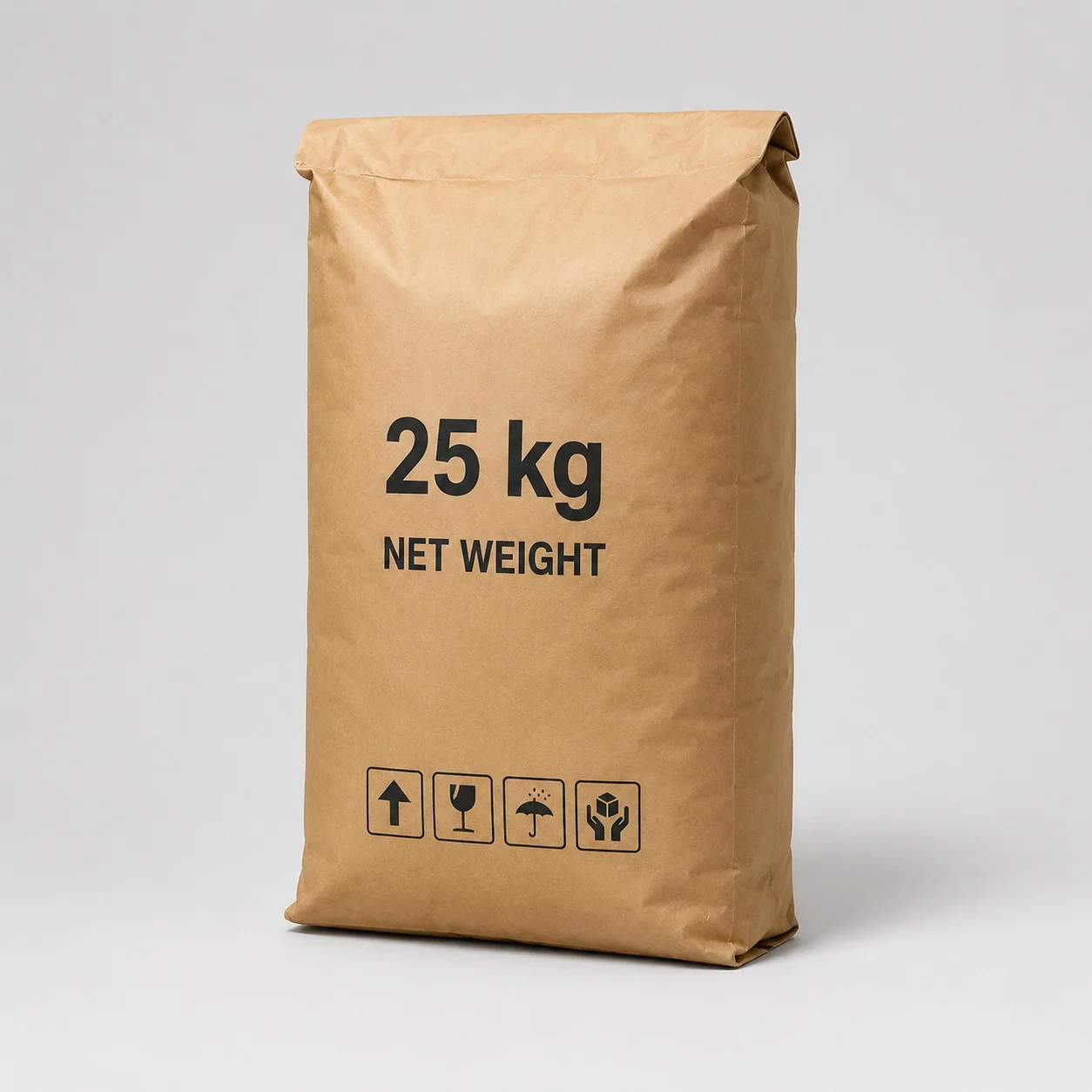
Kiaft paper sutar HOPE Frandent for moet mismails and chemic Suitable for manual handling Paesod FCL
Kiaft paper sutar HOPE Frandent for moet mismails and chemic Suitable for manual handling Paesod FCL
Kiaft paper sutar HOPE Frandent for moet mismails and chemic Suitable for manual handling Paesod FCL
Kiaft paper sutar HOPE Frandent for moet mismails and chemic Suitable for manual handling Paesod FCL
Every certification we hold reflects an auditable commitment — not a purchased sticker. Certificates available for review on formal supplier assessment request.
Third-party certified Quality Management System covering sourcing, processing, QC testing, packaging, documentation, and export of industrial minerals and specialty chemicals.
Scope : All product categories · Annual surveillance audit · Management review semi-annual

All applicable products destined for EU/EEA markets registered under REACH. Substance registration numbers provided on request. Full SDS in GHS format for every product — 16-section format per CLP Regulation.
Coverage : All EU-destined products · Registration numbers on COA on request

Registered Indian exporter under DGFT with active Import-Quality Code (IEC), FIEO (Federation of Indian Exporter Organisations) member, RCMC (Registration cum Membership Certificate) held for applicable product categories.
Enables : All export documentation · FIEO COO issuance

Partnership with NABL-accredited independent testing laboratory for third-party batch verification. NABL-accredited test reports available as supplement or alternative to in-house COA — issued directly by accredited lab on letterhead.
Methods : XRF · PSD · BET · Moisture · Whiteness · Activity Index

Each product listed on the catalog has a Safety Data Sheet (SDS) which is stored in GHS format. In 16-sections format as per UN GHS Revision 9 and EU CLP Regulation (EC) No 1272/2008. Revised as composition or hazard classification or regulatory requirements change.
Format : GHS Rev.9 · Available in English · Other languages on request

All major pre-shipment inspection agencies accepted and coordinated by Ochnology at buyer request. SGS, Bureau Veritas, Intertek, and Cotecna pre-shipment inspections completed regularly. PSI reports available as part of the export document set.
Scope : Pre-loading quantity · Quality sampling · Document review · Container loading supervision
Before adding a new supplier to their AVL, QC managers typically ask the same set of questions: What test methods generate this COA? How do the reported values compare to certified reference standards? What happens if a batch fails internal specification before shipment? Can traceability be confirmed back to the raw material source, and forward to every shipment from that batch? Is documentation available for third-party audit without advance notice? The answers below address these questions directly, using the same testing protocols, standards references, and batch records our existing buyers already rely on during their own supplier qualification process.
Connect with Ochnology for dependable industrial sourcing and supply.