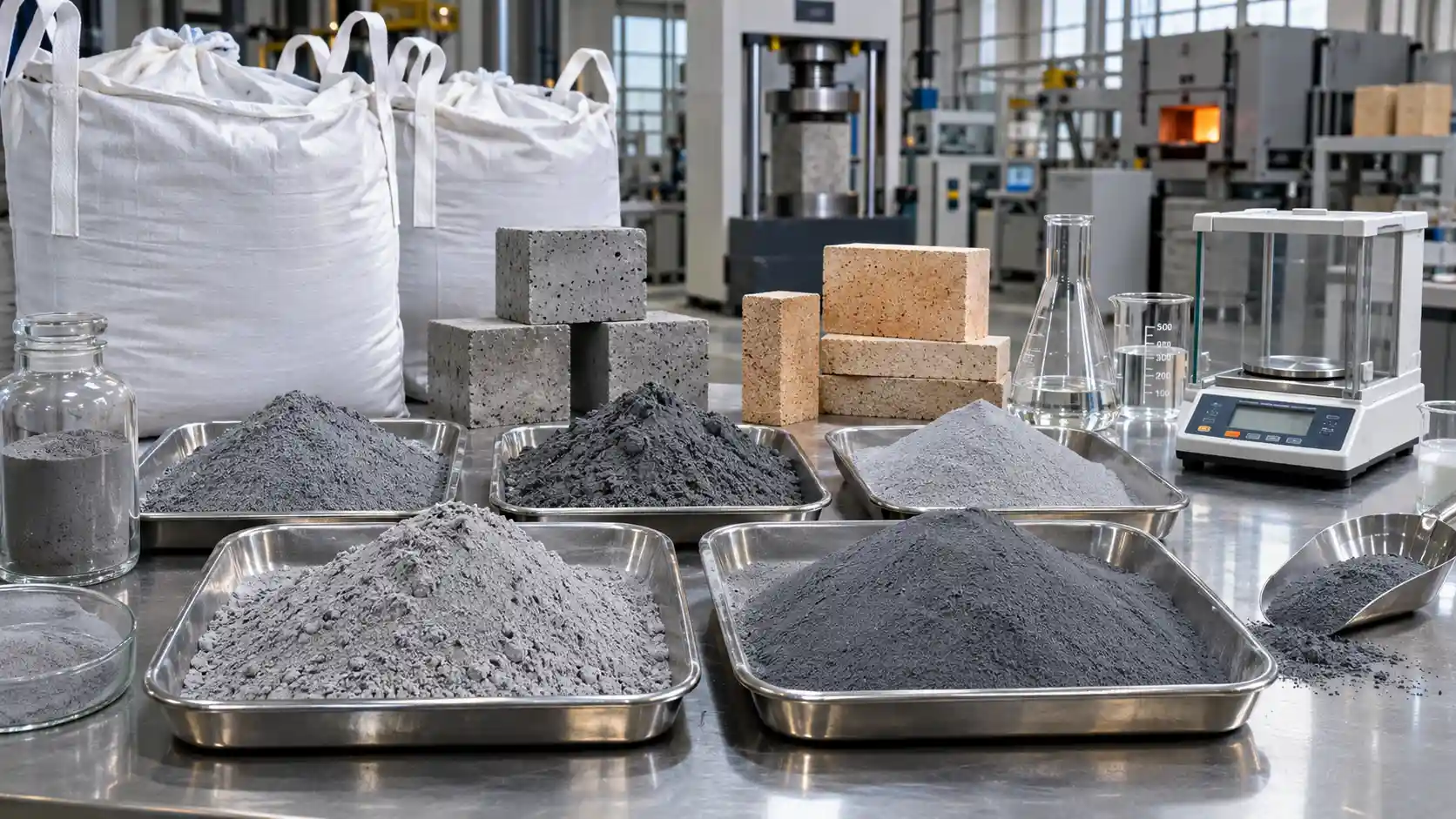
Choosing the correct silica fume grade is a crucial process for construction firms, concrete suppliers, and refractory suppliers. Silicon dioxide percentage, carbon percentage, moisture percentage, particle size, and physical form will affect the use of the silica fume in different industries.
A silica fume that will be effective for structural concrete will not necessarily be effective for refractory castables or ramming mass. Purchasers need to consider more than just the SiO₂ percentage in making an appropriate selection.
This article covers information on silica fume grades and specifications of various types and how to select a silica fume grade for concrete and refractory uses.
Silica fume, also referred to as Microsilica, is a very fine mineral material whose composition consists mostly of amorphous silicon dioxide (SiO₂). It is obtained as a by-product of the production of silicon metal and ferrosilicon alloys. The use of the material results from its ultra-fine particle size and high content of silica.
The use of silica fume improves the properties of concrete through the filling of small voids in the cement matrix and involvement in pozzolanic reaction. In the case of refractory materials, the particle packing is enhanced through the use of silica fume.
For more detailed information on production, properties and uses, please consult our current guide:
What Is Silica Fume? The Ultimate Guide for Concrete Performance & Durability.
SiO₂ is among the first attributes that consumers examine to determine the silica fume grades being purchased. Nonetheless, it is not always the case that a high percentage equates to superior quality.
This is because the suitable grade will be based on its purpose and other characteristics.
| SiO₂ Grade | Typical Selection Consideration |
|---|---|
| 85% | May suit applications where the specified minimum purity is lower and cost is an important consideration. |
| 90% | Suitable for applications requiring moderate silica content, subject to the complete specification. |
| 92% | A potential choice for concrete and refractory formulations requiring higher silica content. |
| 95% or higher | Consider for demanding applications where higher SiO₂ content is specifically required. |
These grades are selection categories, not universal performance classifications. The final decision should be based on the product's COA, TDS and application trials.
Ochnology is a manufacturer and supplier of silica fume. Its Microsilica 94D is a densified grade with a minimum of 94% SiO₂, supplied in 1000 kg jumbo bags and 25 kg bags, and each grade comes with a TDS, MSDS and batch-specific COA so that buyers can compare SiO₂, carbon, moisture and particle size before ordering. Visit the Ochnology silica fume page to review the available grades and request a quotation.
For example, silica fume for concrete may be selected based on strength, permeability and chloride resistance requirements. Refractory applications may require additional attention to carbon, alkalis and particle distribution.
Silica fume is available in different physical forms. These forms influence transportation, handling, storage and mixing.
| Form | Main Characteristics | Suitable Considerations |
|---|---|---|
| Densified Silica Fume | Compacted powder with higher bulk density and easier handling | Bulk concrete supply and transportation |
| Undensified Silica Fume | Loose powder with lower bulk density and greater dust potential | Applications requiring suitable powder-handling systems |
| Slurry Silica Fume | Silica fume mixed with water | Ready-mix plants and controlled wet-batching systems |
Densified silica fume generally occupy less transport volume than undensified material. This can improve freight efficiency, especially for bulk shipments.
Undensified silica fume need better dust control and proper handling. Densified silica fume, in contrast, needs enough mixing energy to break up agglomerates and disperse evenly.
Slurry helps in avoiding handling of dry powder at the batching process. It is important for buyers to pay attention to the water ratio, stability, and compatibility with the concrete mix.
The most appropriate one will depend on the site conditions, batching equipment, means of transport and application.
The below table provides general information about silica fume properties that can help when evaluating the performance of the substance. Actual values may differ depending on the grade and type of the substance. Please, check the final specifications with the supplier's current TDS and COA.
| Parameter | Typical value or note (confirm against COA and current standard) |
|---|---|
| SiO₂ content | About 85 to 98% depending on grade. ASTM C1240 minimum is 85%. |
| Loss on ignition (LOI) | ASTM C1240 maximum is 6%. Many suppliers offer lower. |
| Moisture | ASTM C1240 maximum is 3%. |
| Carbon content | State the value. It affects colour and admixture demand. |
| Oversize on 45 µm sieve | ASTM C1240 maximum is 10%. |
| Specific surface area | ASTM C1240 minimum is 15 m²/g. Typical range about 15 to 30 m²/g. |
| Bulk density | Undensified roughly 200 to 350 kg/m³. Densified roughly 500 to 700 kg/m³. |
| Chloride (Cl⁻) | Important for reinforced and marine concrete. Check the limit in the applicable standard. |
| Strength activity / pozzolanic index | State the test age and method. |
| Packing | 25 kg bags and 1 tonne jumbo bags (confirm what the supplier offers). |
Other parameters buyers often ask for include Al₂O₃, Fe₂O₃ and alkali content (Na₂O equivalent), which matter for refractory formulations and alkali-silica reaction control in concrete, along with pH and the true (particle) density, which is about 2.2 g/cm³ for amorphous silica fume. Ask for the parameters relevant to your application to be reported on the COA.
The standards could differ based on the target market for the product.
ASTM C1240 standard pertains to silica fumes utilized in concrete, hydraulic cementitious systems. ASTM C1240 involves test methods for physical and chemical properties of silica fumes.
The buyer must consult the appropriate version of this standard and determine if the delivered product conforms to the required criteria.
The Indian Standard for silica fume specification is IS 15388. Indian purchasers should verify the version and project requirements before approving any grade.
EN 13263 relates to silica fume used in concrete. This standard may be relevant to those purchasing products under the European specifications.
Numbers are more useful than descriptions when comparing silica fume. The first table shows the specification of Ochnology Microsilica 94D, a densified grade. The second shows results from independent laboratory tests on a densified and an undensified silica fume sample, set against the requirements of ASTM C1240 and IS 15388.
| Parameter | Microsilica 94D (densified) specification |
|---|---|
| SiO₂ | 94.0% min |
| Carbon (C) | 3.0% max |
| Fe₂O₃ | 0.4% max |
| CaO | 1.2% max |
| MgO | 0.8% max |
| Loss on ignition (LOI) | 3.0% max |
| Moisture (when packed) | 3.0% max |
| Particles retained on 45 µm | 5.0% max |
| pH | 5.0 – 9.0 |
| Bulk density (densified, when packed) | 500 – 700 kg/m³ |
| Specific surface area (BET) | 15 – 25 m²/g (typical) |
The results relate to the samples tested and show what a good silica fume report should contain: the test, the method, the result and the requirement side by side. The densified sample passed the 7-day strength activity requirement with a 39.2 MPa test cube against a 36.0 MPa plain cement control. The undensified sample shows the lower bulk density that is typical of undensified material. Always compare these values with the COA for your own batch.
The selection of silica fume changes according to the final application.
Silica fume in concrete is used as a supplementary cementitious material. The fine particles fill the voids in the cementitious matrix, while the pozzolanic reaction improves the performance of the concrete.
Common applications include:
Silica fume is used in refractory castables, low-cement castables and certain ramming mass formulations.
These materials operate under different conditions from structural concrete. Their formulation requires careful consideration of:
Low-cement castables require a carefully balanced particle distribution and water demand. Ramming mass formulations may have different requirements depending on their composition and installation method.
For refractory use, check the impurity limits as closely as SiO₂. The Ochnology Microsilica 94D data sheet lists carbon at 3.0% max, Fe₂O₃ at 0.4% max, CaO at 1.2% max and MgO at 0.8% max, and these values should be confirmed on the batch COA when the grade is evaluated for low-cement castables or ramming mass.
Silica fume is commonly used at around 5–10% by weight of cement in concrete. The actual dosage depends on the mix design and required performance.
The dosage depends on the application. The table below shows typical rates by application for Ochnology Microsilica 94D. These rates are indicative, and the optimal dosage should be confirmed by trial mixes. Silica fume may also replace part of the cement, up to about 15%, for cost and sustainability benefits.
| Application | Typical dosage (% by weight of cement) | Primary benefit |
|---|---|---|
| High-performance concrete (HPC) | 8 – 12% | Strength above 60 MPa, low permeability |
| High-strength concrete (HSC) | 10 – 15% | Compressive strength above 80 MPa |
| Ultra-high-performance concrete (UHPC) | 15 – 25% | Compressive strength above 120 MPa |
| Precast and prestressed concrete | 8 – 12% | Early strength gain, surface finish |
| Grouts and injection mortars | 8 – 15% | Reduced bleed, improved cohesion |
| Marine and aggressive environments | 8 – 12% | Chloride and sulphate resistance |
| Self-compacting concrete (SCC) | 5 – 10% | Flow, stability, reduced bleeding |
| Shotcrete (sprayed concrete) | 5 – 10% | Cohesion, reduced rebound |
Silica fume is available in different packing options, depending on the supplier and order requirements.
Common options include:
First, determine the bulk density, packing size and form (densified or undensified) before placing your order.
Ensure that the silica fume is stored in a dry and covered environment. The bags should remain sealed up to the time of usage.
Before finalising a purchase, buyers should review the following points:
In choosing silica fume manufacturers, consider how well the material fits into the application and its specifications, batch uniformity, and technical literature.
Certain procurement and application errors might have an impact on the performance of silica fumes.
Selection of an appropriate supplier is necessary in order to ensure material stability and reliable procurement.
Tested Product Data: The Ochnology Microsilica 94D data sheet and independent laboratory test reports, covering SiO₂, loss on ignition, moisture, particles retained on 45 µm, pH, bulk density, BET surface area and strength activity index, show buyers exactly what they are purchasing.
The selection of the proper silica fume grade cannot be made by simply comparing the percentage of SiO₂. Buyers need to take into account the entire chemical composition, physical state, moisture, carbon, chlorides and requirements for application. When using it in concrete, the emphasis lies on strength, workability and durability. When applying in the refractory industry, chemical purity, distribution of particles and compatibility with the formulation become important as well.
|
In order to get a quotation from Ochnology, provide the required grade, physical state, volume, and destination port of shipment. |
Silica fume is mainly used in concrete, including high-strength concrete, bridges, marine structures, precast products, industrial flooring and shotcrete, where it increases strength and reduces permeability. It is also used in refractory castables, low-cement castables and ramming mass to improve particle packing and flow, and in oil well cement, fibre cement and polymer composites.
For structural concrete, ASTM C1240 requires at least 85% SiO₂ along with its other limits, so higher grades are not always necessary. Ochnology's densified Microsilica 94D has a minimum of 94% SiO₂ for high-performance and ultra-high-performance concrete. Refractory buyers more often ask for 90% to 95% or higher where purity matters. A higher SiO₂ grade is worth the extra cost only when the application or specification requires it, so check the TDS and COA and run a trial.
Dosage depends on the application, and it is given as a percentage by weight of cement. Typical rates are about 5% to 10% for self-compacting concrete and shotcrete, 8% to 12% for high-performance, precast and marine concrete, 10% to 15% for high-strength concrete and 15% to 25% for ultra-high-performance concrete. Silica fume may also replace part of the cement, up to about 15%, for cost and sustainability benefits. The exact dosage should be set by trial mixes, and because silica fume increases water demand, a superplasticizer is normally needed to keep the mix workable.
Silica fume particles are about 0.1 to 0.2 µm on average, roughly 100 times finer than an average cement particle, and the specific surface area is typically about 15 to 30 m²/g. Densified silica fume is supplied as agglomerates that break down during mixing.
Fly ash is a coal-combustion by-product with much coarser particles and lower SiO₂, and it is typically used at higher replacement levels to reduce cost and heat of hydration. Silica fume is far finer and higher in SiO₂, and it is used at lower dosages to raise strength and reduce permeability.
Silica fume is amorphous silica and is generally not classified as dangerous goods for transport, but the fine dust can irritate the eyes, skin and respiratory tract. Use a dust mask, goggles and gloves, limit dust, and follow the MSDS for the grade you buy.
Dry silica fume does not have a fixed expiry date if it stays dry and sealed. Moisture causes caking and lumps, so store it in a covered, dry place in closed bags and check for lumps before use. Follow the supplier's storage instructions.
Dry silica fume does not have a fixed expiry date if it stays dry and sealed. Moisture causes caking and lumps, so store it in a covered, dry place in closed bags and check for lumps before use. Follow the supplier's storage instructions.
The strength activity index compares the strength of mortar made with silica fume to a plain cement control. ASTM C1240 requires an accelerated pozzolanic strength activity index of at least 105% of the control at 7 days. In an independent laboratory test of a densified silica fume sample, the 7-day index was 108.89%, with a 39.2 MPa test cube against a 36.0 MPa control.
Connect with Ochnology for dependable industrial sourcing and supply.