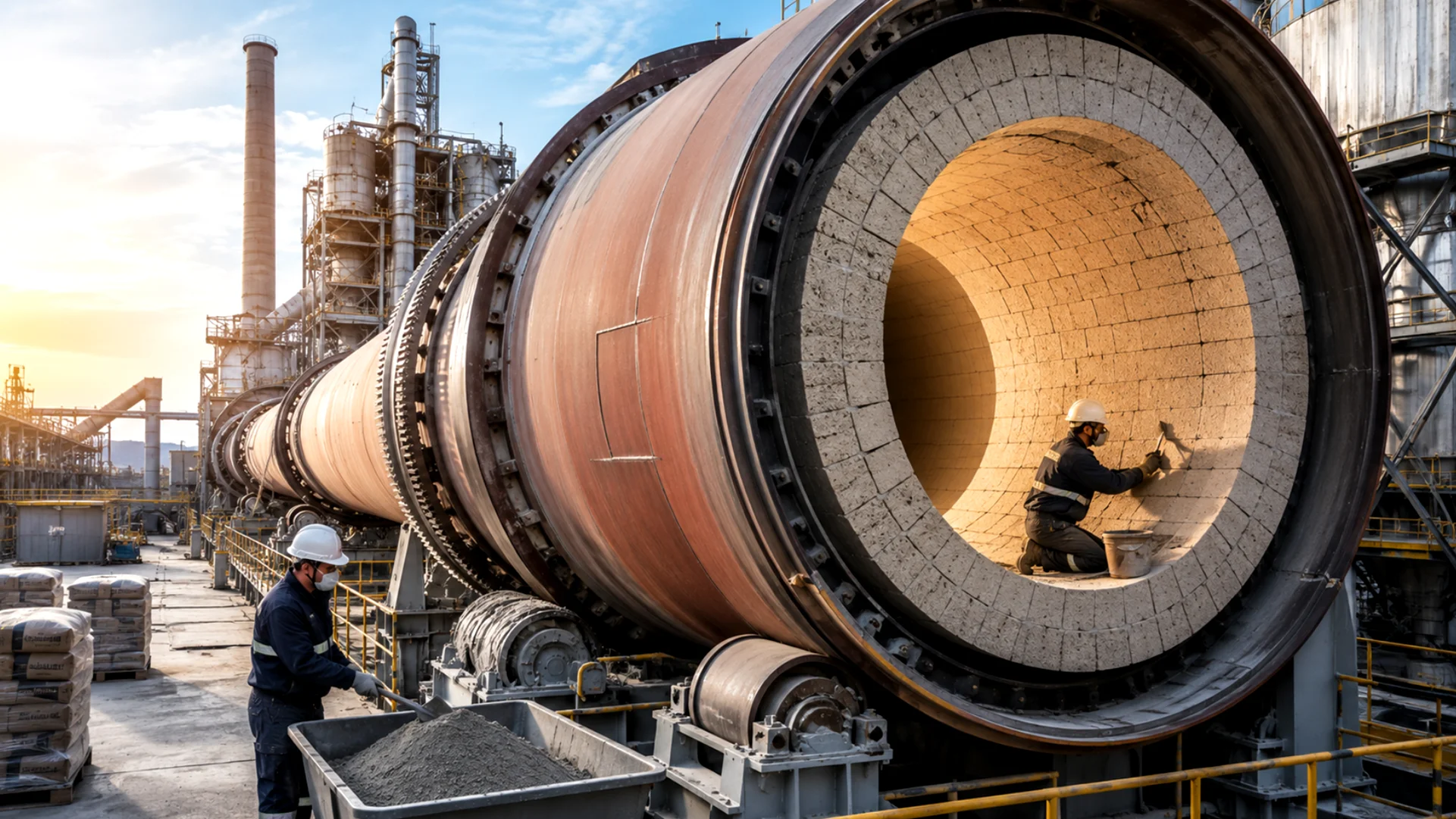
Suppose you are handling a kiln repair of an emergency. One part of the furnace lining is fractured due to thermal shock and the geometry is not regular-- normal bricks will not be inserted easily, and even an hour of inactivity is expensive. In this case castable refractory materials are necessitated: the material is prepared on-site, then poured or sprayed in, and left to stabilize into a smooth monolithic lining, flowing around complex shapes with no mortar joints.
This guide will discuss what refractory castables are, how they are produced, the major types and their properties, their use in industry and how one can choose and install the right grade to match the project that one would need.
Did you know?
A modern castable refractory cement recipie could be that which could be at service temperatures of 800C (even 1,800C) and even low-cement and ultra-low-cement based formulations offered a superior resistance to thermal shock at high-temperature than high-cement formulations.
Refractory castables manufacturated are pre-formed refractory concretes which are pre-formed as a mix that hardens into a single structure that is heat resistant when mixed with water (or other liquids, like binder) and allowed to dry. Unlike ready-made refractory bricks, castables are in the form of dry blends of refractory aggregates, fine powders and binders so that they can be poured, pumped or gunned into whatever shape is needed and restoration.
This non-shaped nature makes castable refractory to be perfect in patch work and irregular furnace designs that require a great deal of cutting and mortar bonding of bricks.
Refractory castables are specially prepared with a well coordinated mixture of the raw materials and binders:
The most important is the binder system: traditional castables contain up to 2.5% CaO cement whereas low-cement (LCC) and ultra-low-cement (ULCC) castables contain 1-2.5% or even 0.2 100% cement replaced with finer alumina matrices.
Castable Refractory cement mixtures come in an assortment of grades, including CA60 and CA70 cement containing 60 to 77 percent Al 2 O 3 with regulated impurities to get the optimum performance at high temperatures.
The refractory castables are classified in terms of density, cement content along with the conditions and service it has to offer:
|
Type |
Cement (CaO) Content |
Key Characteristics |
Typical Use |
|
Conventional (Dense) Castables |
>2.5% CaO |
Good green strength, can be installed easily. |
General-purpose linings. |
|
Low-Cement Castables (LCC) |
1–2.5% CaO |
Resistance to thermal shock, higher levels of hot strength. |
kiln hot faces, ladles made of steel, rotary kilns. |
|
Ultra-Low-Cement Castables (ULCC) |
0.2–1.0% CaO |
Excellent thermal shock, low porosity, high density |
The high-abrasion, high-cycling glass furnaces. |
|
Insulating Castables |
Varies |
Light, poor thermal conduction. |
Backup insulation, energy saving linings. |
|
High temperature Castable Refractory |
Often ULCC/NCC |
Rated for 1,500–1,800°C+ |
Hot areas of cement kiln burning, glass melting tanks, reactors. |
The craftable cast refractory materials are well-mixed to offer a combination of traits to extreme industrial purposes:
A change in the bricks to castable refractory cement systems has a number of feasible benefits:
Castable refractory materials are used in practically every high temperature industry:
Here are the differences between refractory castables and refractory bricks:
|
Factor |
Refractory Castables |
Refractory Bricks |
|
Form |
Unshaped, mixed on-site |
Pre-formed, shaped units |
|
Installation |
Poured, pumped, or gunned |
Laid with mortar, piece by piece |
|
Best For |
Irregular shapes, repairs, custom linings |
Standard shapes, large structural linings |
|
Joints |
Monolithic (no joints) |
Mortar joints between bricks |
|
Repair Speed |
Faster, localized patching possible |
More involved, often requires larger rework |
In practice, many furnaces use both: bricks for the main structural shell and castable refractory for hot-face zones, repairs, or complex geometries.
Proper installation and curing are critical to achieving the designed performance of castable refractory cement linings:
There should be no skimming nor rushing of the cure and dry out process which can predispose to either spalling of the steam or cracks or premature failure.
It is also possible that even very good castable refractory materials can work very badly when improperly used:
The refractory grade to cast is based on a number of considerations which would only apply to the application:
Analysis of castable refractory prescribed values like Al 2 O 3 percentage, bulk density, cold crushing strength and thermal conductivity will have you in line with material capability versus process requirements.
The price of castable refractory cement depends on a number of factors:
The higher price is expected when the quality of the refractory is high temperature and its grade exceeds 1,600 C due to the use of the high grade tabular alumina, low-iron binders and tightening of the quality control.
Ochnology Solution pvt. Ltd. is a renowned producer, distributor, importer and exporter of industrial minerals, specialty chemicals and other mineral products like castable refractory and refractory brick products, catering to the industries in India and 40+ countries headquartered in Dehradun. All of our batches are thoroughly checked to ensure that they are always of very consistent quality and will work well whether done on a new furnace or an emergency kiln repair. We have good supplier networks and extensive logistics knowledge to enable businesses to find the right refractory materials with minimum fuss - supported by appropriate documentation and reliable delivery.
Refractory castables offer a very high-performance and flexible, versatile lining and repairing option to high-temperature industrial equipment - thermally-resistant, chemically-stable, and can be fitted more chameleonically than the boring themselves. Weather its a fresh lining of the kiln, a furnace re-do, or an emergency fix, the decision on the proper castable refractory grade and the proper cure and heat-up steps will provide you with a proper kiln that will last a long time under a sustained heat.
Seeking the appropriate castable refractory cement or high temperature castable refractory to suit your project? Get in touch with our team at Ochnology, and discuss your castable refractory needs and get a quote to match your use. Contact Us Now!
The castable refractory cement grades depending upon composition may be continually served at temperatures between c. 1,000 1,800 o C with special use in 1,500 1,800 o C+ service.
Refractory bricks are molded, pill-like blocks to be laid using mortar, and castable refractory is an unshaped mixture that later hardens into a monolithic lining. Castables are better than ad hoc shapes and fixings, and the bricks are preferable to an overgrown, ordinary building lining.
The majority of castable refractory materials are ambient cured requiring a minimum of 24 hours ambient cure and then controlled dry-out schedule (may require 20-30 hours more depending on the lining thickness).
Yes - that is a major benefit of castable refractory cement systems; it is possible to patch or re-cast damaged areas locally without having to re-cast the entire lining.
In most requirements of repairs especially non-uniform geometry repair and where downtime is instantaneous, castable refractory materials would be faster and less costly. Still, with large structure rebuilds that are standard sized, one can use bricks.
Connect with Ochnology for dependable industrial sourcing and supply.