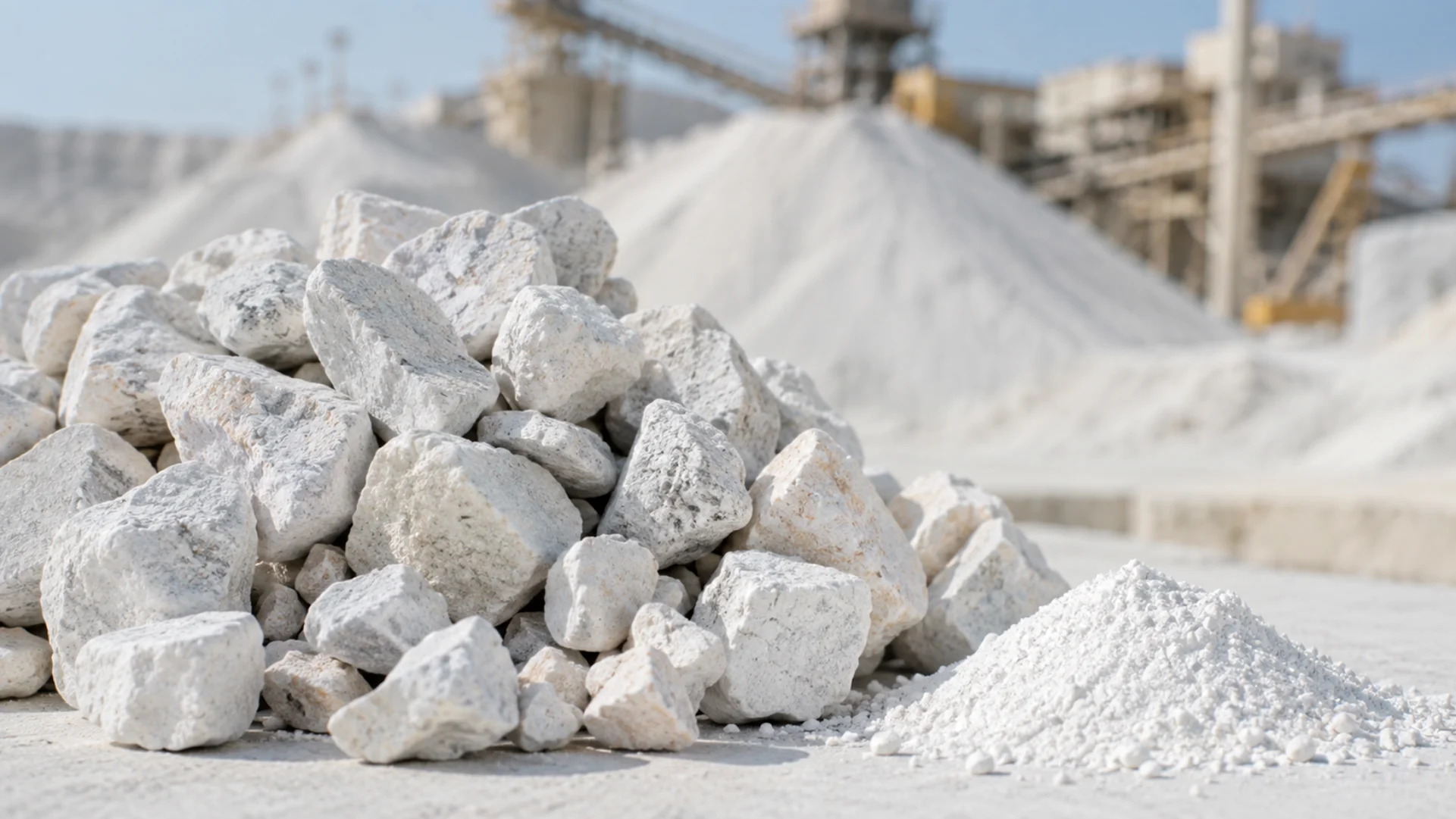
Barytes or barite or baryte is a mineral that is naturally occurring, and is mainly constituted of barium sulfate. Having the chemical formula BaSO4BaSO_4BaSO4, barytes is characterized by the fact that it is quite dense and quite chemically stable, white in color, and has a very low solubility in water. These are the qualities that render it a significant industrial mineral in drilling fluids, paints, coatings, plastics, construction materials and medical imaging.
Here, we are going to define what barytes is, its composition, properties, processing, its primary uses, advantages, drawbacks and considerations when choosing which grade of barytes we will use.
The natural mineral Barium sulfate is barytes. It is also typically present in hydrothermal veins, sedimentary rocks, and deposits that are related to other minerals. Depending on the impurities that are in the ore, the mineral can be white, colorless, gray, yellow, brown or even reddish.
The metal is called barytes, because of its abnormally high specific gravity. It can also be referred to as heavy spar as it is much heavier compared to other non-metallic minerals.
Barytes ore after mining is pounded, washed, separated, dried and ground to powder. Its completed product comes in various grades and particle sizes to be utilized in various industrial processes.
The words barytes and barium sulfate are most related and are not necessarily the same product.
Where high density is a consideration and the cost is a factor then natural barytes is normally the option of choice. Precipitated barium sulfate is usually used in high-brightness applications, uniform size of particles, controlled morphology, and high dispersion.
Barytes powder is not purely a mineral deposit but equally the processing method employed by the manufacturer determines how good the powder will be.
Barytes is mined at an open pit or underground mines. The mine process chosen is subject to the geology, form (shape) and the depth of the deposit.
Barytes ore is crushed into big chunks which are broken into smaller fragments. The process of crushing also simplifies the process of separating mineral desired and unwanted rock and soil.
The ore can be washed to get rid of clay, dust, and other loose impurities.
Beneficiation enhances purification and quality of barytes. Usual techniques can be gravity separation, flotation or magnetic separation and other mineral-processing techniques.
The refined barytes is made into a fine powder. There are various grinding systems, which give the coarse, fine or micronized grades.
The powder can be categorised based on the size of the particle. It is also essential in paints, coatings, plastics, rubber and printing inks in that the particles are of a uniform size.
Lastly, the barytes powder is dried, sampled, and filled depending on the customer needs and use.
Manufacturers can also use a chemical reaction to manufacture precipated barium sulfate in specialty applications. This enables a more intimate regulation on purity, particle size, brightness and surface features.
Barytes finds the most common use in the oil and gas sector where its most common use is as a weighting agent in drilling fluids. Water insolubility, high specific gravity and chemical stability enable it to augment the density of drilling mud resulting in the regulation of the pressure on underground formations, the introduction of the rock cuttings to the surface, lubrication of the drill string, and decreasing chances of well blowouts during drilling activities.
To make drilling mud thicker, ground barytes is combined to aid in controlling the pressure within a well and to minimize the occurrence of formation fluids entering a wellbore. Drilling fluids based on barytes are beneficial in assisting:
The grade used should be appropriate in terms of the necessary particle size, density, purity and flow properties.
Barytes is a functional filler and extender used in industrial, automotive and decorative as well as marine coatings and enhances:
Fine barytes powder is used to give a smooth finish and its chemical stability enables long-lasting usage in extreme coating systems.
To Plastic & rubber compounds Barytes are added to densify formulations and alter physical properties, it finds application in:
The right grade is based on the polymer system, the loading level used and the mechanical properties wanted - too much loading will lead to lower flexibility or process.
The density and barium content of barytes render it to be used in radiation-shielding concrete, plaster and composites, frequently employed in:
It is usually applied together with some binding substance as opposed to being applied alone.
The gastrointestinal tract is outlined using radiopaque contrast media made of medical-grade barium sulfate which is used in some X-ray and CT procedures to block X-rays. This is a specially high purity, medical grade material- it should never be used as a substitute of industrial barytes powder.
Barytes aids high-density concrete and building material that needs an additional weight or attenuation of radiating patterns such as:
Its dense nature enables manufacturers to obtain additional weight without a lot of extra material volume.
Barytes and barium sulfate are also found in printing inks, masterbatches, adhesives, ceramics, glass, brake linings, friction materials, paper coating, pigments and electronic components. Due to the difference in performance with grade, make sure to always align the technical specifications with needs of your application.
Barytes has a number of benefits as an industrial mineral and functional filler:
These advantages enable barytes to find applications in mass industrialization as well as high-end products.
The barytes product on the right is based on technical needs of the end-use.
Before purchasing, request the following information from the supplier:
Barium sulfate is nearly not soluble in water, however barytes dust may pose an occupational exposure hazard in the mining, grinding, pouring, and packing of barium sulfate. The product safety data sheet is to be adhered to, with appropriate dust-control precautions being taken by workers.
Handling recommendations involve:
The insoluble barium sulfate and the soluble barium compounds also need to be differentiated and the toxicological properties of the compounds may be varied. The existing safety documentation of the supplier should be consulted by industrial users.
Ochnology provides quality application specific barytes solutions which are supported by a consistent quality and professional supply service.
Ochnology Solution pvt. Ltd. is a renowned producer, distributor, importer and exporter of industrial minerals, specialty chemicals and other mineral products like castable refractory and refractory brick products, catering to the industries in India and 40+ countries headquartered in Dehradun. All of our batches are thoroughly checked to ensure that they are always of very consistent quality and will work well whether done on a new furnace or an emergency kiln repair. We have good supplier networks and extensive logistics knowledge to enable businesses to find the right refractory materials with minimum fuss - supported by appropriate documentation and reliable delivery.
Barytes is a clear-cut industrial mineral whose chemical formula is BaSO4BaSO_4BaSO4. It has a high density, low water solubility, chemical stability, as well as is available in various grades, thus useful in drilling, coating, plastics, rubber, building, and the medical industries.
The trick to barytes performance lies on its purity, particle size, density, brightness, moisture and dispersion. Manufacturers can enhance product density, durability, stability, shielding capability, and overall formulation efficiency by choosing the appropriate grade to use in the desired application with the barytes. To get the best quality product, contact Ochnology now!
Yes. Barytes, barite, and baryte generally refer to the same naturally occurring barium sulfate mineral.
No. Barytes is practically insoluble in water because barium sulfate has very low solubility.
It is mainly used in oil and gas drilling fluids, paints, coatings, plastics, rubber, construction materials, radiation shielding, and medical imaging.
Barytes increases the density of drilling mud, helping control underground formation pressure and support safer drilling operations.
Yes. Barytes can function as a filler or extender in paints and coatings, where it may help improve density, smoothness, hardness, and chemical resistance.
Natural barytes is mined and mechanically processed. Precipitated barium sulfate is chemically manufactured and generally offers more controlled purity, particle size, brightness, and dispersion.
Connect with Ochnology for dependable industrial sourcing and supply.