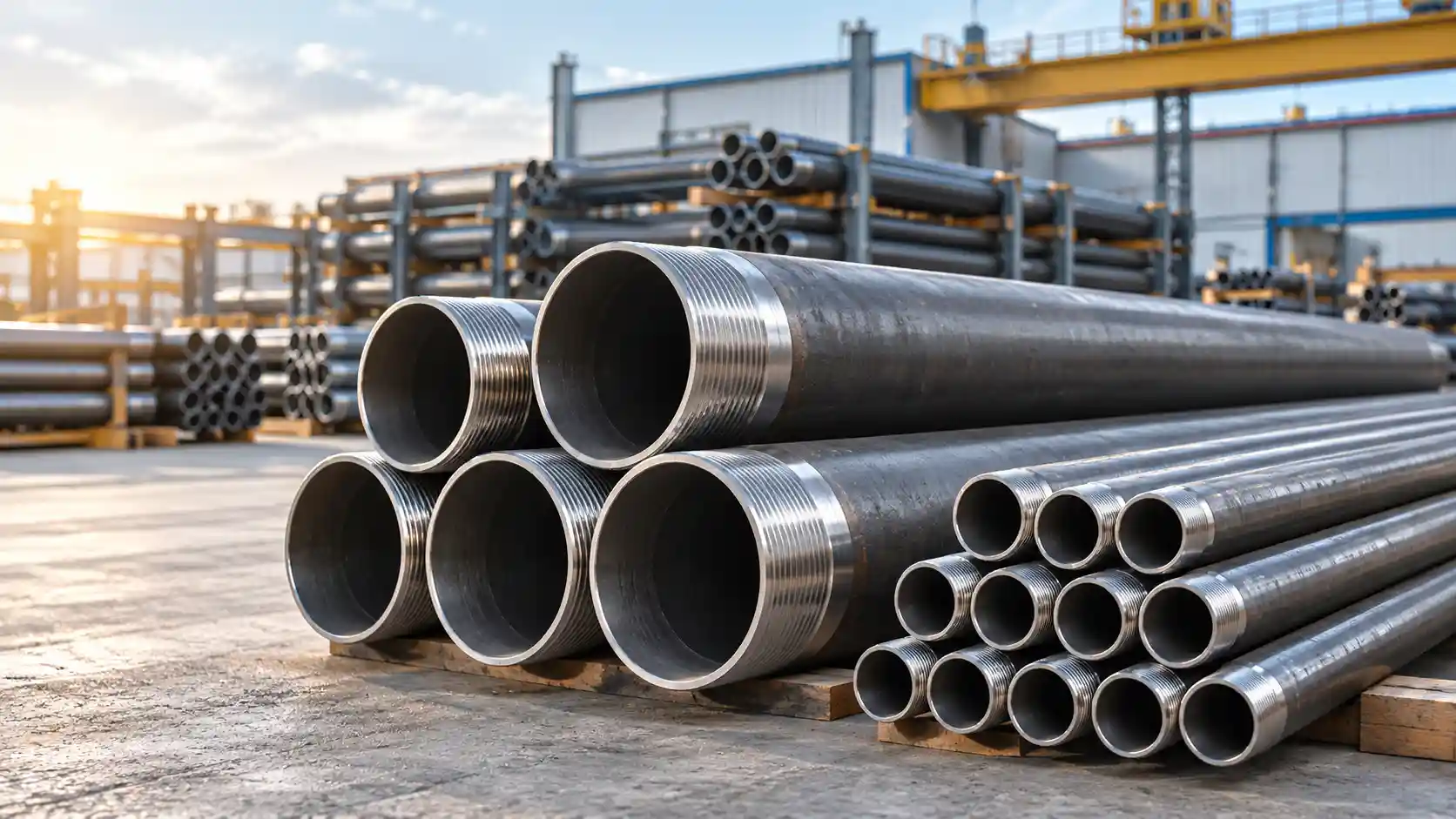
Casing and tubing are steel pipes that are vital to use in oil, gas and water wells. Despite their similarities in appearance, casing and tubing have different functions in the wells. The function of casing is to support the wellbore and separate formations underground.
Casing vs tubing information provides an insight for customers to choose the right pipe that fits their requirements. It all comes down to several factors including the depth of the well, pressure, temperature, size, grade, and type of connections.
Before buying casing and tubing (casing pipe and tubing pipe), buyers are advised to review the specifications and API standards.
OCTG means Oil Country Tubular Goods. These are the steel pipes utilized in oil and gas wells. Mainly these pipes are used for drilling and transferring the oil and gas to the surface.
OCTG includes three kinds of steel pipes:
Both casing and tubing are made in accordance with API Spec 5CT standard, while drill pipes should conform to API Spec 5DP. Line Pipes (API 5L) differ from OCTG pipes. Line pipes are used for transportation of oil, gas or water above the ground level.
Casing pipe refers to a pipe made of steel that is set into a borehole well in order to provide structural stability to the hole. The process of drilling leads to instability of the surrounding rock formation.
Casing pipes are typically set in stages as the drilling progresses downwards. Casing pipes can be accompanied by cement in order to hold the pipe in place.
Casing performs several important jobs:
Choosing the correct steel casing pipe is determined by well design and underground conditions. People who need oil well casings must verify certain requirements such as diameter and steel grade before ordering.
There are usually multiple casing strings used for any single well. Different strings serve different purposes:
A tubing pipe is used to transport fluids such as oil, gas, and other production fluids from the well to the surface. A tubing pipe is typically placed inside the casing and forms part of the well's production string.
The basic difference between the two is that the casing will provide support for the well, while the tubing will give a channel through which the fluids will move. Based on how the well is designed, it is possible to remove the tubing without removing the casing.
Some of the important functions of tubing pipe include the following:
Oil well tubing and other types of oilfield tubing should be selected according to the well's production needs and operating conditions.
The key differences between casing and tubing are their functions. Casing aids in the strengthening of the wellbore, whereas tubing facilitates the transportation of produced fluids from the wellbore to the surface.
The table below illustrates their primary distinctions.
| Parameter | Casing | Tubing |
|---|---|---|
| Outside diameter (typical range) | About 4-1/2 in to 20 in | About 1.050 in to 4-1/2 in |
| Common connections | STC, LTC, BTC, premium | NUE, EUE, premium |
| Length ranges | Range 1: 16 to 25 ft. Range 2: 25 to 34 ft. Range 3: over 34 ft | Range 1: 20 to 24 ft. Range 2: 28 to 32 ft |
| Product specification level | PSL-1, PSL-2, PSL-3 (confirm which apply to the grade) | PSL-1, PSL-2, PSL-3 (confirm which apply to the grade) |
| Manufacture | Seamless. Welded (ERW) for some grades only | Seamless. Welded (ERW) for some grades only |
| Related standards | API 5CT (pipe), API 5B (threads) | API 5CT (pipe), API 5B (threads) |
Although both products may be made from steel, they cannot simply replace one another. Each must meet the technical requirements of its intended use.
Casing and tubing have primary applications in a well that are distinct from one another.
Casing pipe is used to:
Tubing pipe is used to:
Requirements for oil and gas casing and tubing will vary based on the project. Although casing is used in water wells as well, it will have to be specific to the drilling requirements.
It is essential to check the casing and tubing specifications prior to purchase. Two pipes can be of similar outside diameter with varying thicknesses, materials, or connections. This can determine the suitability of a pipe for a certain well.
Buyers should check the following details:
The project or drilling team should confirm the required dimensions before an order is placed.
Connections are used to connect pipe segments. They should be appropriate for the well operating conditions and compatible with other equipment.
Ensure the following prior to ordering:
API specification 5CT deals with the requirements of casing and tubing products. API specification 5B provides the specified threading, gauging and inspection specifications. The buyer should verify applicable specifications for his/her products.
Proper pipe choice is also based on the well's operating conditions. Such conditions include:
Considering all these parameters will help the buyer choose the proper casing pipe and tubing, rather than choosing based on price alone.
Verify the most recent API 5CT edition to ensure accuracy of all sizes, connection information and dimensions prior to printing.
|
Parameter |
Casing |
Tubing |
|
Outside diameter (typical range) |
About 4-1/2 in to 20 in |
About 1.050 in to 4-1/2 in |
|
Common connections |
STC, LTC, BTC, premium |
NUE, EUE, premium |
|
Length ranges |
Range 1: 16 to 25 ft. Range 2: 25 to 34 ft. Range 3: over 34 ft |
Range 1: 20 to 24 ft. Range 2: 28 to 32 ft |
|
Product specification level |
PSL-1, PSL-2, PSL-3 (confirm which apply to the grade) |
PSL-1, PSL-2, PSL-3 (confirm which apply to the grade) |
|
Manufacture |
Seamless. Welded (ERW) for some grades only |
Seamless. Welded (ERW) for some grades only |
|
Related standards |
API 5CT (pipe), API 5B (threads) |
API 5CT (pipe), API 5B (threads) |
API 5CT Casing and Tubing Standards
The API 5CT standard, issued by the American Petroleum Institute (API), provides technical criteria for steel casing and tubing. This standard involves all necessary details about the products concerned, such as grades, sizes, and required end finishes.
An understanding of the API 5CT casing and tubing will help the buyer formulate clear specifications and verify if the supplied items satisfy the specifications provided by the buyer.
Prior to making the purchase, make sure that the following details are verified:
API Spec 5CT gives the specifications of casing and tubing that are utilized in the oil and gas industries. Buyers are advised to make reference to the most recent versions of API specification in order to ensure compliance with the necessary specification standards.
Note, however, that simply because a product is stated to conform to an API standard, this is not enough to conclude that the manufacturing company holds an API license. Potential buyers must confirm this information before buying API 5CT steel pipe.
Casing & tubing grades are classifications of materials with particular technical and mechanical characteristics. Each grade is chosen depending on the design of the well and working conditions.
Some common grades are:
These grades cannot be substituted. It doesn't mean that the high strength grade is suitable for all wells. Buyers need to confirm the grade and product type according to the project specification.
| Grade | API group | Yield strength, min to max (ksi) | Typical use (confirm per well design) |
|---|---|---|---|
| H40 | 1 | 40 to 80 | Shallow, low-pressure wells |
| J55 | 1 | 55 to 80 | Shallow to moderate depth. Widely used for casing and tubing |
| K55 | 1 | 55 to 80 | Similar to J55, with a higher minimum tensile strength |
| N80 (Type 1 and Q) | 1 | 80 to 110 | Moderate depth and pressure. Type Q is quenched and tempered |
| L80 (Type 1, 9Cr, 13Cr) | 2 | 80 to 95 | Controlled hardness for mild sour service. 13Cr for CO2 corrosion |
| C90 | 2 | 90 to 105 | Sour service, controlled hardness |
| T95 | 2 | 95 to 110 | Sour service, controlled hardness |
| P110 | 3 | 110 to 140 | Deep, high-pressure wells. Generally not for sour service |
| Q125 | 4 | 125 to 150 | Very deep, high-pressure wells |
Sour service (hydrogen sulfide) selection in accordance with NACE MR0175/ISO 15156. 1ksi is equivalent to 6.9 MPa. Values obtained from API 5CT. Check this against the latest version and mill test report.
Selecting the correct piping begins with an assessment of the requirements of the well. The customer must provide precise technical information to enable the product to be evaluated in light of these requirements.
The following must be taken into account prior to ordering:
A clear purchase order should specify the type, grade, dimensions, connection, quantity and documentation requirement of the piping.
Choosing a casing and tubing supplier involves more than comparing prices. Buyers also need clear product information, suitable documentation and reliable communication.
Ochnology lists casing and tubing products for oil, gas and water-well applications. Information on its products includes choices like J55, L80, and C90. It is advisable for purchasers to establish the current availability and connections beforehand.
The company describes checks covering pipe dimensions, threads, material-grade documentation, surface finish and traceability. Its website also lists COA and MSDS documents among its shipment documents. Buyers should confirm which documents apply to their particular order.
Ochnology claims to have exported to over 40 countries and The company also claims that their export team answers all queries within 24 working hours. The buyers need to verify the cost, lead time, documentation, and other delivery terms while quoting.
The website mentions FOB, CIF, and FOR in their methods of shipping. Depending upon the location, number of orders, and business terms, the method can be determined.
In case of a comparison between casing and tubing manufacturers or casing and tubing exporters in India, the buyers need to verify the real manufacturers and documents.
In order to be able to provide you with a quotation that suits your project, it is required that you give us information regarding pipe size, thickness, grade, type of connection, length and number of units. The port of destination, as well as any other specifications you may require, must also be considered.
Contact Ochnology to discuss product availability and your project's casing and tubing requirements.
Deciding between casing and tubing will be easier once you know what each type of pipe is used for. Before purchasing your pipes, think about the requirements of your well, pipe size, pipe material grade, and connections.
If you need help deciding what kind of pipes you should choose for your project, contact us at Ochnology!
OCTG refers to Oil Country Tubular Goods which are the steel tubes used for drilling and completing oil and gas wells. This category of tubes includes casing, tubing and drill pipe. Casing and tubing are produced according to API Spec 5CT whereas drill pipe is produced in accordance with API Spec 5DP.
API 5CT is the specification that describes technical requirements for the steel casing and tubing. There are also relevant technical requirements for dimensions, grade and end finish of the product.
These are types of casing connections. Short thread coupling (STC), Long thread coupling (LTC) and Buttress thread coupling (BTC). BTC is commonly used when higher joint strength is required. Mention the connection in sequence.
Controlled hardness grades like L80, C90 and T95 are used in the presence of Hydrogen Sulfide according to NACE MR0175 / ISO 15156. P110 is not recommended for sour service applications. Contact your well engineer.
A line pipe is used to transport oil, gas and water at surface level, for example from well to a refinery, and complies with API 5L. Casing is a downhole product that is designed to bear well loadings and is produced in accordance with API 5CT.
Yes, apart from API 5CT casing and tubing, Ochnology also offers drill pipe, line pipe, pup joints and couplings, API wellhead valves, ball valves and mud pump and BOP spares. We just need your specification and requirements, and we will verify the availability and documentation details.
Connect with Ochnology for dependable industrial sourcing and supply.