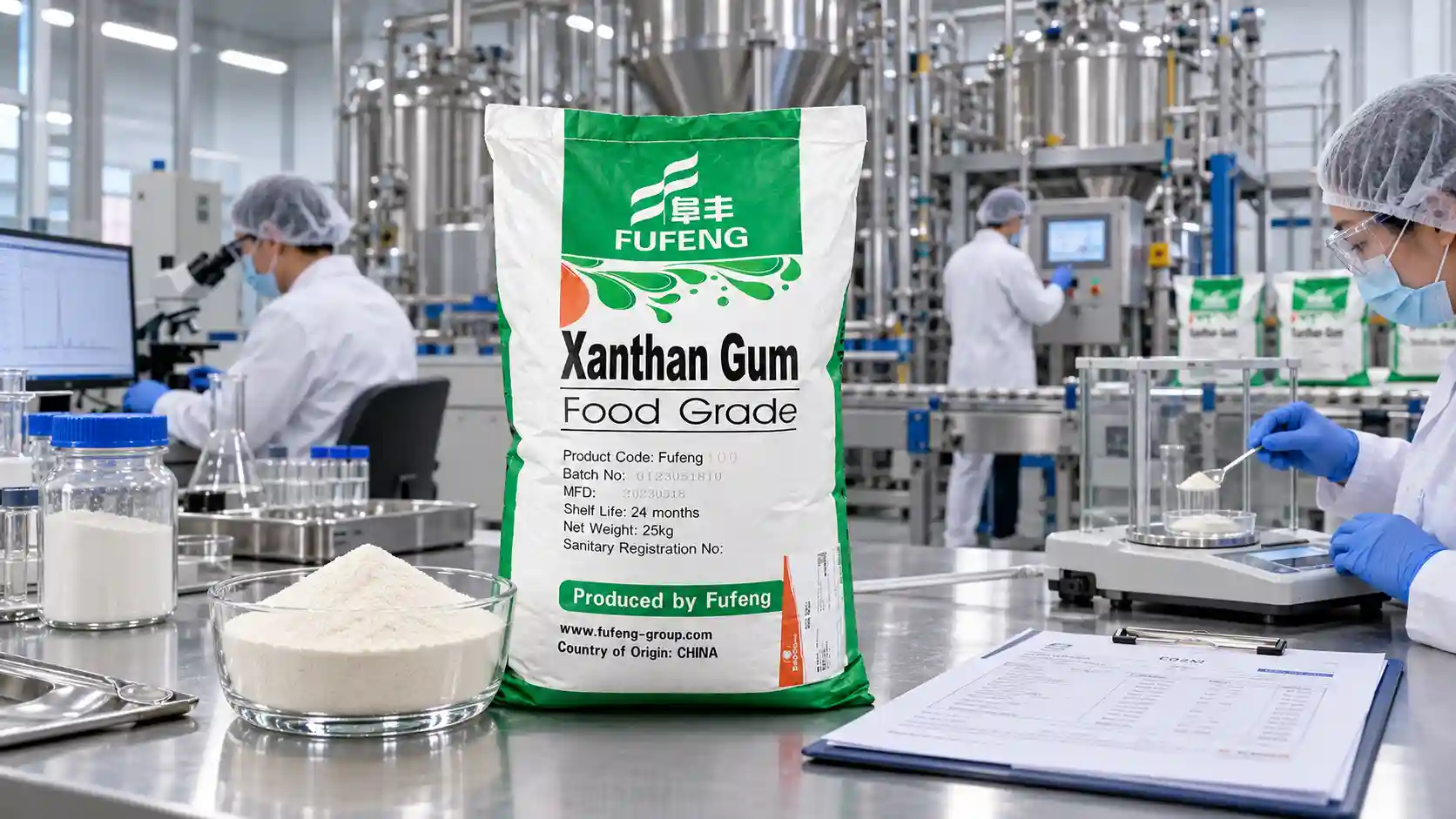
Food-grade xanthan gum. Pharma-grade xanthan gum. Same powder to the eye — not even close underneath.
Ever compared two bags of xanthan gum side by side — one food-grade, one pharma-grade? Same off-white powder. Same faint texture. You'd never tell them apart by eye. But open the spec sheet and suddenly they're two completely different materials. Pharma use means a stricter bar, period. Tablets. Suspensions. Topical creams — this stuff ends up inside products people swallow or rub on their skin. So yeah — the bar should be higher.
This isn't some obscure technicality either. Formulators deal with it. Procurement teams deal with it. Quality managers lose sleep over it. Get the grade wrong and you're not looking at a bad batch. You're looking at a compliance problem. So let's break it down properly — what pharma-grade actually means, and why that BP/USP tag matters more than most buyers give it credit for.
Compare it to food or industrial variants and pharma-grade xanthan gum powder just goes through more — tighter controls, tighter everything. It's made via microbial fermentation — Xanthomonas campestris does the work — then purified hard. Residual proteins. Heavy metals. Microbial contamination — the purification step is built to chase all three out. At Ochnology, this level of control is standard practice across every pharma-grade batch.
Here's the thing though: "pharmaceutical grade" isn't a vibe. It's a compliance claim. It's tied to real pharmacopoeial monographs — not internal guesswork. Here's what that looks like on the ground:
Don't assume "high purity" on a label means pharma-ready. It might not. Ask for the monograph reference. Every time.
BP and USP — Europe and Americas Pharmacopoeia — are the two big reference standards for pharmaceutical excipients worldwide. Both recognize xanthan gum. But the testing parameters? Not identical. Close, but not identical.
What do these specs actually cover?
A batch can pass BP and still miss USP. Happens more often than you'd think. Buyers working across international markets often need both certs on one COA (Certificate of Analysis). That's not always simple to find.
Why does this pharmaceutical excipient keep showing up everywhere? Simple — it works, and it works predictably.
It's a strong thickening agent and stabilizer, even at tiny concentrations. Under 1%, sometimes, and it still transforms how a liquid formulation flows. It's also pseudoplastic. Viscosity drops when you shear it — stirring, pumping — then bounces back at rest. Genuinely useful when you need something pourable that won't settle on the shelf later.
A few other things worth knowing:
Nothing exotic here. Just dependable behavior, well-documented over decades. Which, honestly, is exactly what a formulator wants.
Did You Know: “Xanthan gum solutions hold their viscosity even through repeated freeze-thaw cycles — something a lot of rival thickeners just can't do.”
Xanthan gum uses in pharma cover more ground than people expect:
Formulators like predictability. Small dosage tweaks, predictable viscosity shifts. No guesswork once the batch is characterized.
Pharma's the focus here, but let's not pretend food and cosmetics don't matter to procurement teams too — a lot of buyers juggle multiple grades at once. Xanthan gum uses in food shows up in sauces, dressings, and gluten-free baking, where it basically stands in for gluten's structural job.
In xanthan gum in cosmetics, it thickens and stabilizes lotions, serums, and gels. Xanthan gum for skin formulations sit a bit closer to the pharma-cosmetic line, though — sometimes demanding purity levels standard cosmetic grade just doesn't hit.
Before you sign off on any pharmaceutical procurement, check these against the actual COA - Certificate of Analysis :
|
Quality Parameter |
What It Indicates |
Why It Matters |
|
Viscosity (1% KCl solution) |
Thickening strength |
Drives formulation dosing accuracy |
|
Loss on drying |
Moisture content |
Impacts shelf stability, handling |
|
pH (1% aqueous solution) |
Acid/alkaline balance |
Confirms formulation compatibility |
|
Heavy metals |
Contamination level |
Regulatory and safety compliance |
|
Microbial limits |
Bioburden |
Blocks contamination downstream |
|
Pyruvic acid content |
Structural marker |
Confirms authenticity, performance |
Don't just glance at a COA and move on. Confirm it's batch-specific. Confirm it's current. Confirm it names the right pharmacopoeial standard.
Trivia: “USDA researchers stumbled onto xanthan gum in the 1960s while screening bacterial fermentation byproducts.”
Xanthan gum price shifts a lot depending on grade. Pharma-grade almost always costs more than food or industrial, sometimes a lot more. Why's that?
If a pharma-grade quote looks suspiciously cheap? Question it. It wasn't a good deal to celebrate. There's a reason for the caution, too — fake and duplicate xanthan gum is in circulation now, and the food grade material has been re-labeled as pharma grade and sold at low prices.
Honestly, this step trips up a lot of buyers. Search "xanthan gum near me" or "xanthan gum powder near me" and you'll get a map, not a quality guarantee.
What actually matters:
Ochnology operates as a B2B supplier across specialty chemical categories and sits among the xanthan gum manufacturers in India and a wider pool of xanthan gum suppliers buyers weigh against this checklist. When it comes to xanthan gum, Ochnology is a source of the original xanthan gum, not a lookalike, and the original Deosen brand is a pharmaceutical grade (BP/USP) xanthan gum. That said — the due diligence above holds regardless of which xanthan gum supplier in India or xanthan gum wholesale suppliers you're evaluating.
Fact: “No heat needed to hydrate xanthan gum fully. Starch-based thickeners? They usually can't skip that step.”
Pharma-grade xanthan gum and its food or industrial cousins aren't the same thing. Not even close. BP and USP specs exist because pharma applications genuinely demand more — tighter control, real verification. For procurement teams and formulators, the challenge isn't finding someone who sells xanthan gum. That part's easy; anyone with a warehouse can claim to sell it. The hard part's finding someone who proves, batch after batch, that the paperwork actually matches what's inside the bag.
|
Sourcing pharma-grade xanthan gum? Connect with Ochnology and ask for a batch-specific COA before you commit. |
Yes, within the concentrations formulators typically use — it's non-toxic and non-irritant, which is why it's stuck around in oral suspensions and topical creams for decades. The catch isn't the material itself, it's proving you've got the right grade. Nobody's word counts for much here — the COA is what actually proves it.
Nope, not one. Plant sugars go in, a bacterium called Xanthomonas campestris does its fermentation work, and polysaccharide comes out the other side — animals never enter that equation at any stage. Chasing a vegan or plant-based label on your finished product? This one's an easy tick.
Cold water works fine. No heating step required, which sets it apart from several other hydrocolloids that need a temperature trigger before they'll hydrate properly. It disperses and thickens at room temperature without extra effort — one less variable to control during formulation, especially useful for heat-sensitive activities.
Sometimes, yes. It depends on the manufacturer, but several offer grades at different viscosity bands or mesh sizes built for specific applications rather than one standard product. Don't assume the default grade automatically fits your formulation — ask what's available before committing to a batch order
Natural. It's a fermentation product, not something built through synthetic polymerization, so most filings document it as a naturally-derived excipient. Region to region, the wording shifts a little — nothing drastic, but enough that checking local requirements beats assuming one phrasing works everywhere.
A GMP certificate and an MSDS are the baseline in most cases. Some destination countries also ask for a certificate of origin, and depending on the shipment's route, stability data or a TSE/BSE-free declaration might come up too, even though xanthan gum has no animal origin at all.
Connect with Ochnology for dependable industrial sourcing and supply.